
‘Messaging’ exhibit on display in M Hall
A piece of artwork with a prominent question mark sets the tone for the exhibition currently on display in Memorial Hall entitled “Messaging: Text and Visual Art.” Because the thought of messaging connotes text or instant messaging, the exhibit explores ways that language and messages have changed with technology.
The question mark piece, titled “Question?” by Edward Ruscha, is a perfect example of this theme. Ruscha usually creates images with words, but with “Question?” he uses the punctuation symbol rather than the word. This is similar to language used today in messaging, like using “2” instead of “to.”
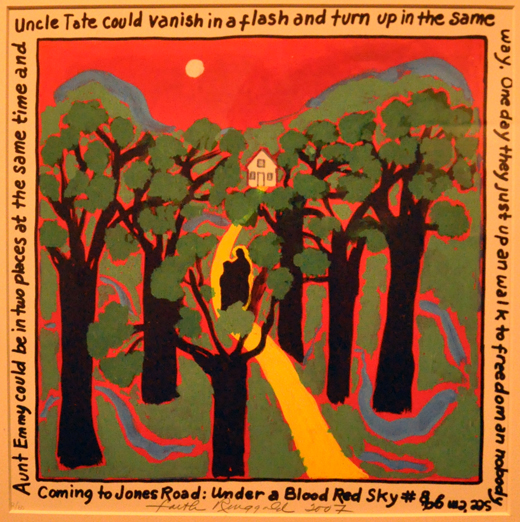
“Coming to Jones Road: Under a Blood Red Sky #8” by Faith Ringgold, on display in Memorial Hall, traces the path slaves make on their way to freedom.
An unusual untitled piece in the exhibition is by Jenny Holzer. This piece is part of her “Truisms,” a series of statements that Holzer composes and publishes in various forms, such street posters and T-shirts. The Truisms piece in M Hall is a LED electronic unit that flashes phrases such as “you are a victim of the rules you live by” and “a little knowledge goes a long way.” Even after ten minutes, not every message has looped through the display. Some messages are touching and moving, while others are empowering. Some make little sense. Still, all of the phrases convey their own messages and ideas.
Another piece by Jenny Holzer is “Die Fast and Quiet When They Interrogate You or Live So Long That They Are Ashamed To Hurt You Anymore,” a piece on brushed aluminum which sports the same message as the title.
“Read Between the Lines” by Barbara Kruger has the dictionary entry for “story” with red writing that urges viewers to “read between the lines.” Kruger’s work often criticizes consumerism and media. Because of her work as an editor for Conde Nest publications, Kruger uses her background in advertising in her artwork. The idea of “Read Between the lines” is that people should read critically because even the printed word can be false.
“Coming to Jones Road: Under a Blood Red Sky #8” by Faith Ringgold explains how two people get to freedom. The piece is a series of prints about the Underground Railroad, in which the artist incorporates text to tell a story.
“Four Sweets” by Julia Jacquette has candy bars with titles like “your lips” and “your eyes,” things that the artists consider to be sweet. This piece has an underlying tone of sexuality.
“Four Sweets” is not the only piece with the theme of sexuality; Adele Henderson’s “Stamen” has the definition of stamen, the male reproductive organ of a plant, a picture of a flower, and a person posed in the background.
While each piece in the exhibition is its own unique piece, some of them make little sense. The piece “Watermelon” is aesthetically pleasing, but has an ambiguous statement that “no man is a watermelon.”
“Fountain” by Marcel Duchamp is a etching of Duchamp’s original “Fountain,” which was simply a urinal on a podium. The re-creation, which was done in 1964, is done on plain tan paper with brown etching. It not only does not make any sense; it also is not very attention-grabbing.
Overall, the pieces in this “Messaging” exhibition are interesting and unique. Each piece tells a story and gives its own message, not only with pictures, but with text.
This exhibition is put on by the Sheldon Museum of Art at the University of Nebraska-Lincoln. It will be in Memorial Hall’s Main Gallery until Sept. 26.