
Lisitsa Live at CSC
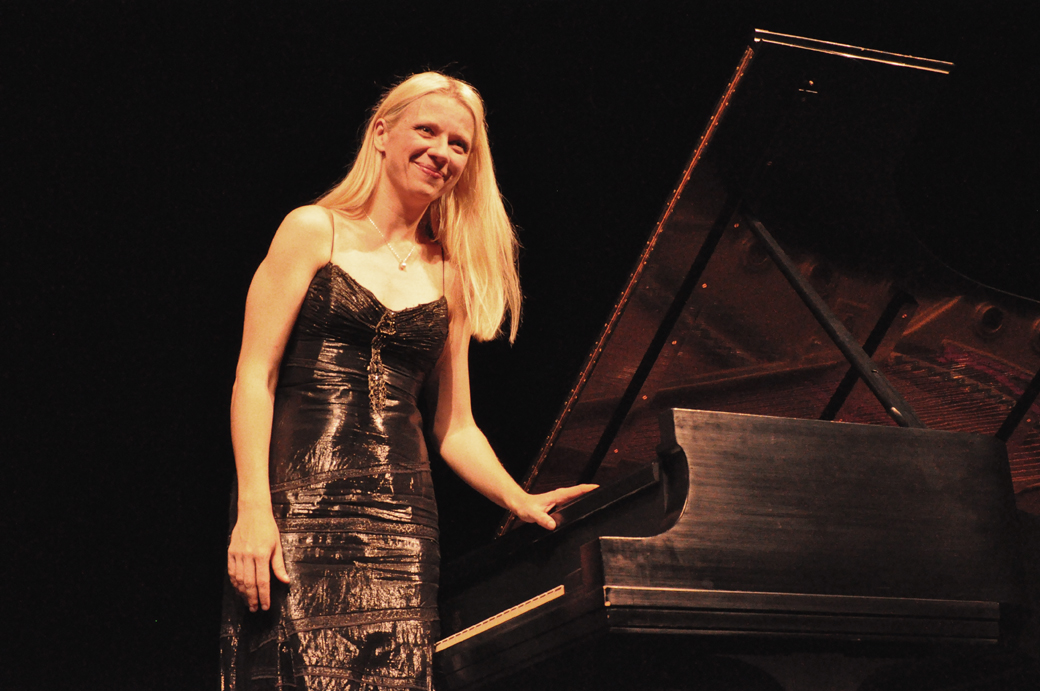


Valentina Lisitsa kicked off the 2010-2011 Galaxy Series Monday with a piano performance in Memorial Hall’s main auditorium.
Lisitsa’s performance started out shaky. Her first song “Etude-Tableau in A minor Opus 39 No. 6” by Sergei Rachmaninoff started loud and ended the same way. There was little variation. Sometimes she plays so fast, the notes seemed muddled. The music seemed to run itself over.
However, by the second piece, Lisitsa’s performance improved. It was a softer piece that brought out her talents further. The audience could hear the music rather than a muddled jumble of notes.
It was when Lisitsa played the piece “Prelude in B Minor Opus 32 No. 10” that her concert really picked up. There was wonderful contrast in this song. It started out soft and gentle, but with a quick tempo. There were often times when Lisitsa’s hands moved so fast on the piano, they barely seemed to touch the keys to bring out the sound. The piece had a feel that there would be more to it, and it certainly delivered. The soft light beginning slowly evolved into a piece that was alive and moving. At the end, two long, low chords rung out for what seemed like an eternity as a completely still, awed audience held their breath.
Lisitsa then played a three part piece by Ludwig von Beethoven entitled “Appasionata.” The first part was described in the program as “quiet and ominous.” It had a dark feel to it, but would quickly switch to feeling light and buoyant. The rapid switches obviously kept the audience engaged. It was also plain to see that Lisitsa was enjoying it herself. There always seemed to be a ghost of a smile on her face. As the music got more complex, it showed in the way she sat up proudly and played with all her heart.
The Chopin pieces were all quiet unique. They were all very light and airy, and most showed off her amazing skill.
One of the only things to complain about in Lisitsa’s performance was the whopping total of sixteen Chopin pieces. While each song was beautiful and unique, after the sixth one, they all seemed to blend into each other. Thus, by the end of the sixteen pieces, it felt as though Lisitsa had played one one-hour piece. The result was a fidgety audience, and an inability for many to keep track of which piece exactly Lisitsa was on.
The song “Hungarian Rhapsody No. 2” by Franz Liszt was a good choice for Lisitsa to end on. This song could only be described as fun. Its quick tempo and complex runs were enough to make a person’s head bob. This song was also possibly the most familiar to many in the audience. The program explains the song has been used in many cartoons.
Almost as soon as “Hungarian Rhapsody” was over, the audience shot out of their seats with ear-splitting applause. Lisitsa graciously accepted the applause, exited the stage, then had to come back as the applause seemed never-ending. Even after she left the stage the second time, the applause continued on.
Overall, Lisitsa’s concert was excellent. Her playing was wonderful and her tone was sublime. The audience obviously enjoyed it quite immensely.