
‘Ornery Times’ – Holst remembers childhood tempered by the Great Depression
(This is the second in a four-part series on the life and “Ornery Times” of Chadron resident Don Holst.)
Don Holst, 81, of Chadron, was born during the Great Depression and grew up during World War II.
Of his birth and upbringing, Holst said, “I was conceived the day the stock market fell. So I was off to a good start. When I got a little older, we had a world war. It was ornery times.”
One of Holst’s earliest memories, from when he was five years old, is the death of his grandfather, Nels Marinus Holst in 1935. Nels Holst was a musician and composer who emigrated to the U.S. from Denmark in 1872.
“My dad brought me into a room where he was in bed and told me to shake hands. I didn’t even know how to shake hands,” Holst said. “Shortly after that, when I was out of the room, he died. I still have a real clear memory of that day.”
After his grandfather’s death, Holst said his family had so little money, his father had to sell a buzz saw for $40 to buy a suit in which to bury Nels Holst.
Holst said his grandfather was a great composer, transposer, and conductor, though he only went to school until the fourth grade. Nels Holst published a book on harmony when he was only 25. And when President Franklin Delano Roosevelt came through Topeka, Kans., in 1932, Nels Holst led the band that played “Stars and Stripes Forever.”
Holst still has an overflowing folder of his grandfather’s compositions, written out by hand on preprinted staff paper. In grayed, barely visible pencil, their titles read “Overture to Universal Peace, 1920” and “Viking, 1923.” The musty pages are bordered with mud, but the ink of the notes remains clear. Holst said they survived a 1941 disaster flood in Marysville, Kans.
Though his childhood was tempered by the privation of the Great Depression and the necessity of hard work from an early age, Holst said it was not without its fun and fond memories.
Holst spent his free time as a kid mowing lawns for 15¢ to 20¢ and shoveling snow from walks and drives in the winter for 25¢ to 30¢ depending on how deep the snow was. He also caught catfish in the Big Blue river, which he could sell in town for 35¢ per pound.
At 10 years old, Holst was a school crossing-watchman, a job that came with a white belt and badge. “I really felt important being able to bring a large truck to a screeching halt on old gravel Highway 77,” he said.
He also worked after school for the Larabee Feed Mill, on shifts from 5 p.m. to 2 a.m., making around 60¢ an hour. Holst remembers he was young and small enough that he was unable to lift the 100-pounder feed bags. During his freshman year of high school, he worked as a ticket taker at the Isis Movie Theatre, for $8 a week and all the popcorn he could eat.
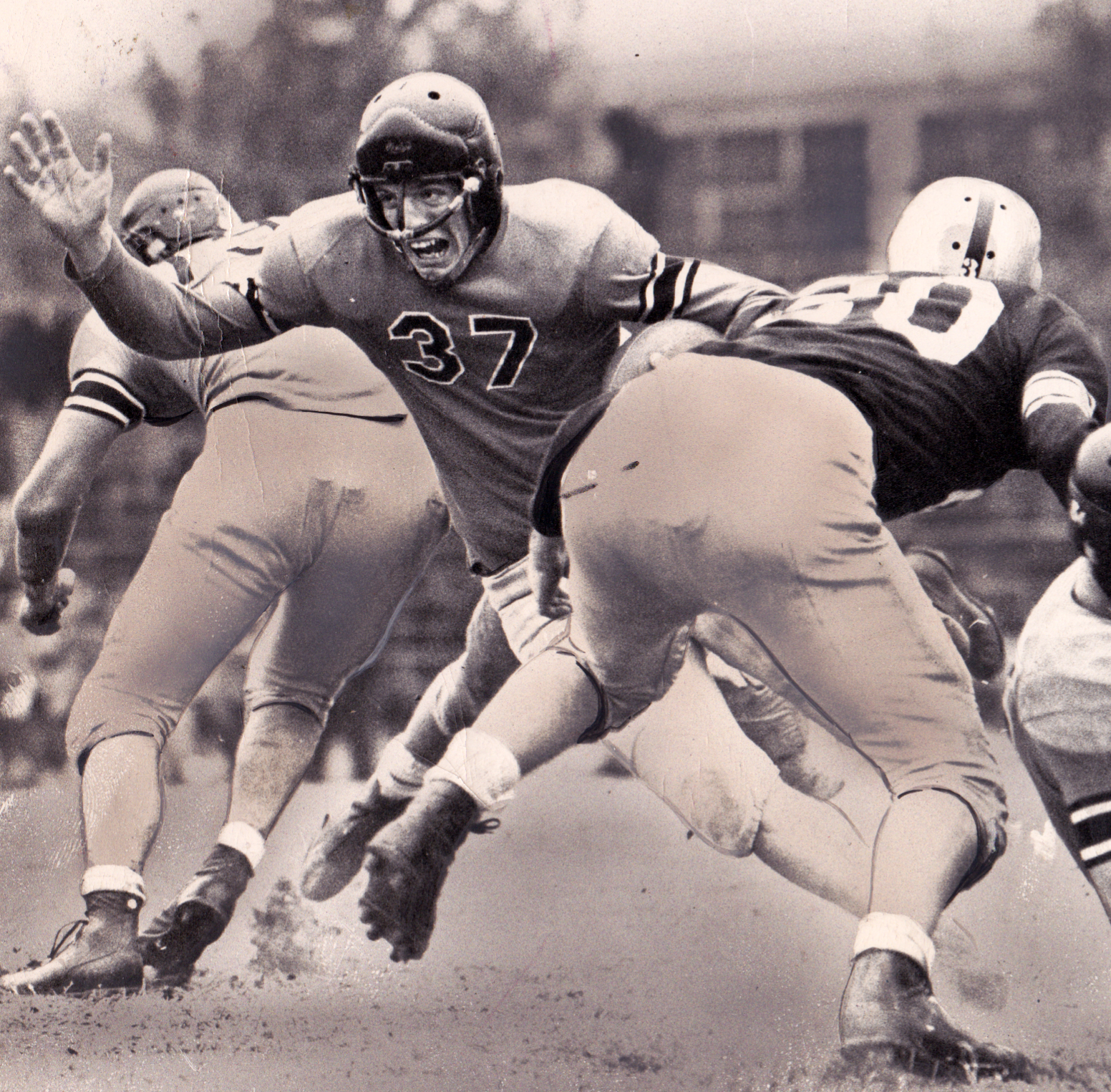
Amid the hard work, high school sports were a highlight for Holst. He participated in track and football all four years. Despite his father’s objections to playing football, his mother quickly became his biggest fan.
During Holst’s time playing football at Marysville High School–from 1944-1948–the team was undefeated for 28 games over 3 1/2 years. MHS was the best team in Kansas, with 1,076 total points versus only 73 scored by its opponents.
Holst went on to play football and run track in college, but said nothing could quite compare to his high school experience.