
Age-old melodies reach young ears
The Men’s Ensemble, composed of eight gentlemen, begins the performance. Immediately the group’s pitch precision lifts their performance above the standard fare. It sounds as though the men utilize every pleasant note in the piano’s lower spectrum, and they do so accurately. This gives the slower choral pieces a living quality, which adds complexity and helps keep the fidgety audience interested. The group should be applauded on their ability to carry the audience’s attention through sedate songs. Particular selections, like “I carry your heart with me” (by David C. Dickau) or “Sing Your Way Home” (by Joseph M. Martin) could have fallen on bored ears, since they have slower tempos and no modern flair. To counter this, the Men’s Ensemble fills the Arts Center’s church-like interior with praise-worthy harmonies, locking the audience’s attention.
Another admirable facet of the Men’s Ensemble is their careful diction. This became an asset during their final song, “Diner” by Martin Sexton. The group tackles Sexton’s tongue-twisting lyrics with alacrity, especially the two soloists, Brendan Mead and Lane Swedburg, whose energy completes the song. After this vocal celebration the men’s performance is brought to an upbeat close, and the women’s ensemble files in.
At this point, it must be noted that Chadron’s vocal music program demands its students to learn pieces in many languages, sculpting the singers into musical polyglots. Accenting this fact, the Women preform a German piece, “Liebst du um Schönheit,” as their first song. They even give the traditionally guttural language an elegant beauty, making it audibly attractive.
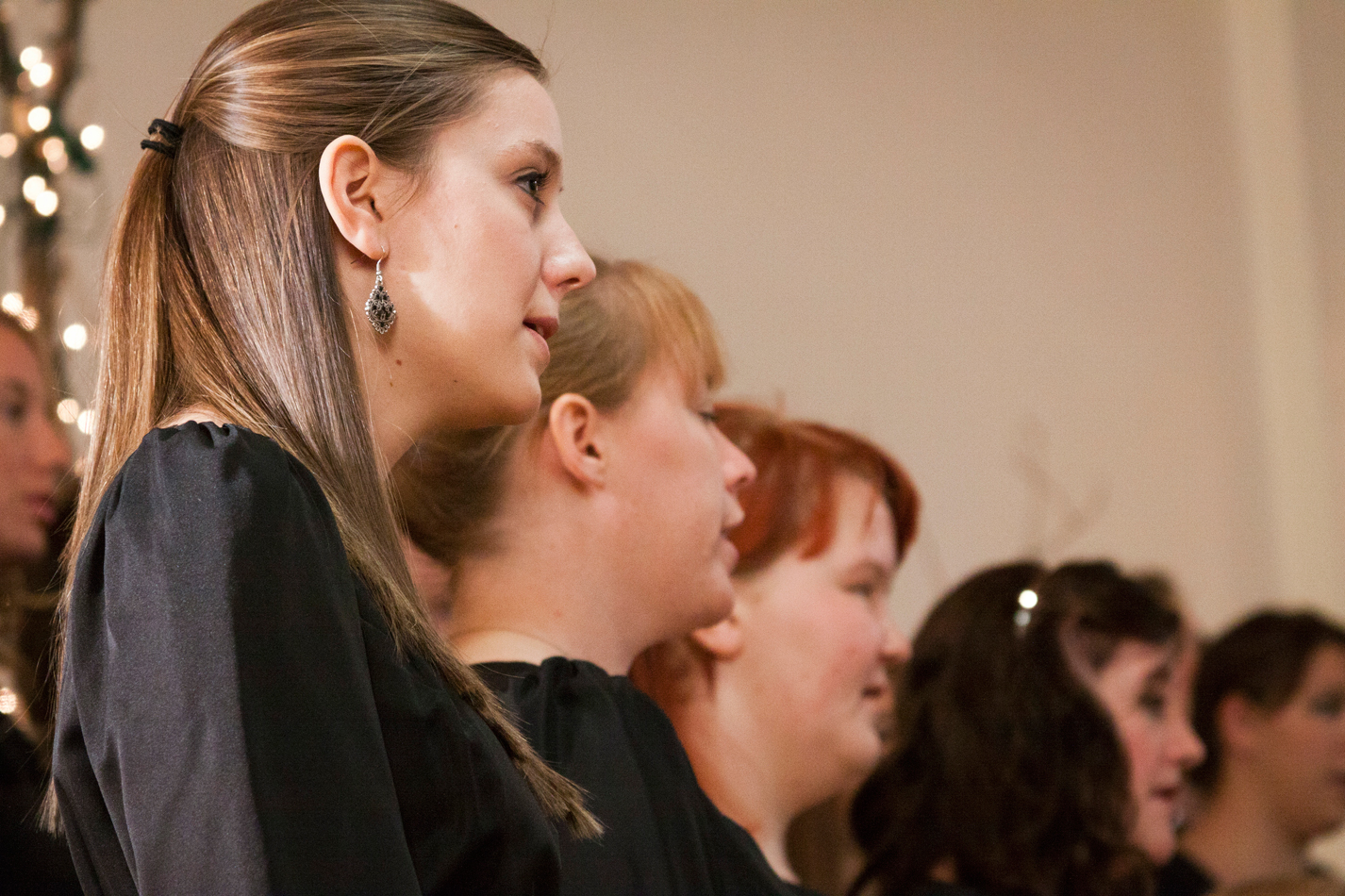
The women’s selection, entitled Arioso, is comprised of all female composers. The ladies are memorized, singing without cumbersome folders, and possess impressive vocal unity. All of these factors combine to make a professional performance.
Dr. Taylor’s program of female composers exhibits a nice variety of moods. The ladies carry anything well, from upbeat pieces, like “Butterfly” (by Nancy Telfer) – which Dr. Taylor summarized as “a description of a butterfly’s flight” – to darker compositions like “Away, Far down the River” (arr. Alice Parker). The brightest piece, “Sail Away, Ladies” (arr. Judith Herrington), is sung as the Women’s Ensemble’s finale. After one flub in the beginning, where Taylor remarked, “okay, let’s try that again,” the piece picked up, with the singers clapping in time.
A far more stunning piece is “Steal Away”, arranged by Marylou India Jackson. The soprano soloist, Lauren Morris, robs the audience and transports them to a place where only this soulful spiritual exists.
The rest of the program contains the full concert choir, who run a vocal gambit of eight songs, with languages including German and Swedish, and compositional variety spanning five centuries. The only distraction arrives at the beginning pieces, where conductor Joel Schrueder channels the whole music through his body. Unfortunately, some of the performers swayed unconsciously with him. This presented the audience with a musical sea anemone at points. Fortunately, this stopped as soon as it began, thanks to the varying tempos of every song.
A crowd favorite is “The Spheres” from Ola Gjeilo’s Sunrise Mass. Chadron resident Martha Empson said, “I don’t know of any other college with such close harmonies. The Spheres was my favorite. I could hear the beautiful overtones, which only come from singing in such close harmony.”
The special sound of “Spheres” is haunting. Inside the Art’s Center, the setting sun fills a circular porthole in a stained-glass window, mimicking the song’s subject matter.
The piece “Spheres” and its compliment, “Phoenix,” are sung in Swedish. It is a testament to the choir then, that despite the unfamiliar dialect, the audience can still understand the song’s meaning. Although the program’s printed translation is helpful, the listeners glean much more than just lyrics, and even these are versed in subtle ways. The audience understands the songs from the unwritten language of emotion, which every singer is fluent in.
Another excellent example of this effect is “Your Fragrance” by Edward Henderson, who wrote it with an Islamic melody and tempered it with raga influences. The choir’s vocal percussion adds flavor, and they do the song’s mixed origins proud. The “choral sway” makes a return in this piece, but somehow it only adds to the complex rhythmic flavor.
Another rhythmically enticing song is “Doluri,” a Georgian drum song from the former Soviet Union. Despite the fact that it contains copious amounts of vocal percussion and a difficult native language, the melody is never muddled, and the tones remain carefully clear.
At the concert’s close, a warm reception of local faces stand in applause for the Chadron singers. Though there are tight-palmed audience members, who seem to feel the performance doesn’t deserve their full appreciation, these are a stingy minority. The public of Chadron, like Martha Empson, really enjoyed it.
“The show was exquisitely planned,” Empson commented after the evening. “All the different voices made it sound very whole. The singers transmitted something beyond what words or emotions can encompass. It was wonderful.”