
Art Exhibit leaves viewers guessing
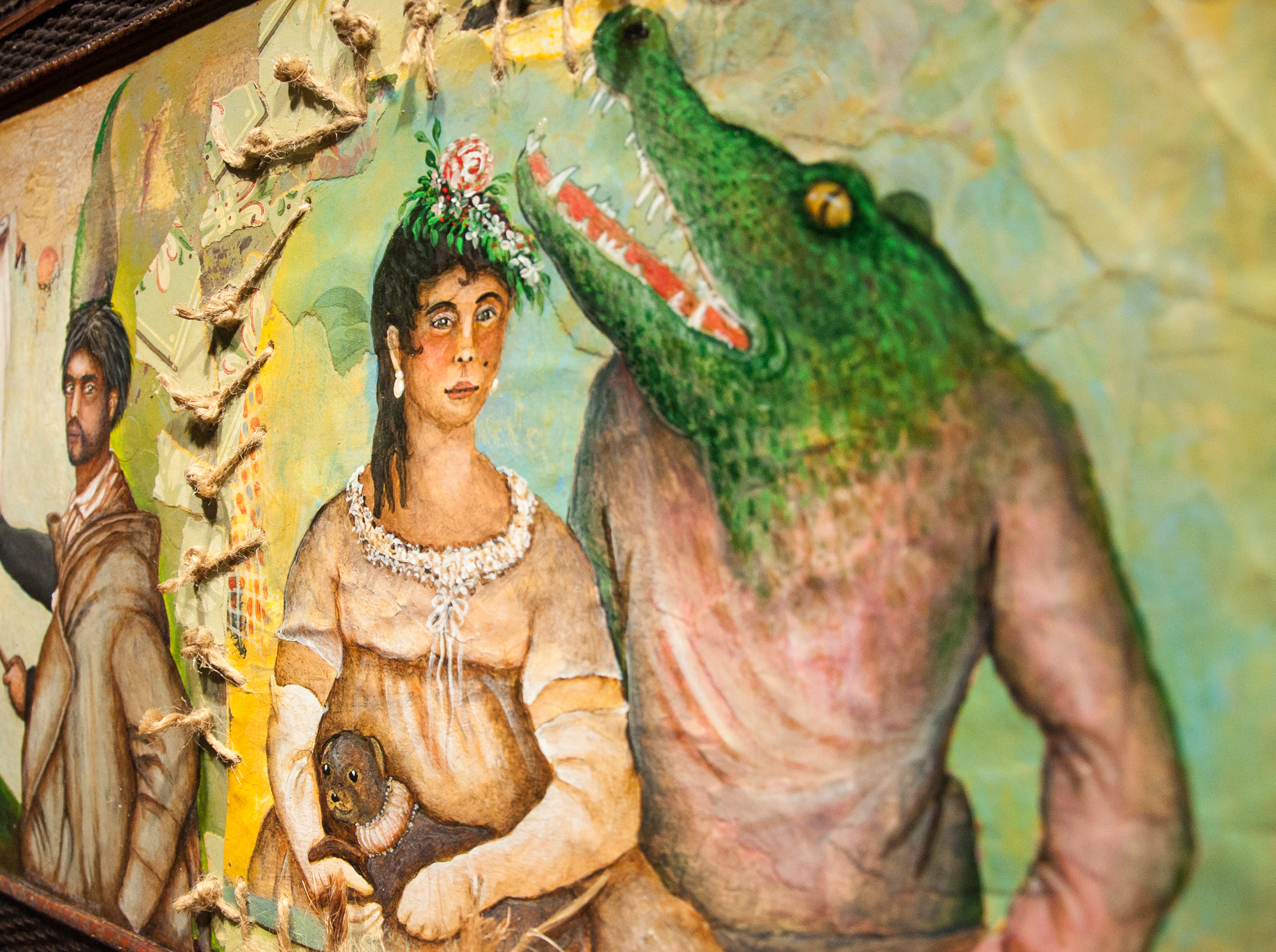
Twelve baffling pieces hang on the felt-covered walls. There are mermaids and overcoats, demons and dresses, fires and feather caps. This week, Alejandro Mazon, a Cuban-born artist based out of N.Y., brings his unique blend of Spanish and Cuban influence to the upstairs gallery of Memorial Hall, showing until Feb. 1st.
Although a compelling craftsman, Mazon leaves his audience wondering. Off of one piece, “The Butterfly Dress”, hangs ten metal symbols, tied to fraying fabric, which spill out of the picture frame. These symbols are, from right to left: S R 9 C 5 E 0 8 I and the silhouette of a boot. Some gallery patrons may be bemused, others confused, by Mazon’s esoteric choices.
One piece, “Bird House”, features a hanging box lined with illustrated dictionary pages and sided with painted, contemplative men. Inside, Mazon suspended a gold-leafed acrylic painting of a bird. Behind the bird hangs another box with an explosion scene, complete with a bazooka-wielding toy soldier. A strange pairing indeed.
These and other pieces are a result of Mazon favoring, in his words, “vintage” materials, like wallpapers, boxes, prints, and fabrics, which combine like a Hispanic hope chest with his paints. Bits of culture and experience are covered with intriguing Cuban faces, and this approach ties together each of Mazon’s works.
The show’s only negative aspect was a disappointing gallery arrangement, with three pieces lacking tags.
For style, Mazon blends traditional Hispanic portraits with strange compositions and antiquated scraps. In “The Butterfly Dress”, a woman in traditional finery smiles with her hazel-haired lapdog. This looks normal, except for the woman’s portrait partner, a man with a crocodile head. This juxtaposition of traditional-looking Latino portraits and barbarism highlights Mazon’s unique outlook and diverse background.
One of the unlabeled pieces has two elliptical canvases, the first showing an erupting volcano, and second shows a demure Victorian woman, wearing an enormous feathery hat, posing for a portrait. The volcano from the first panel smokes menacingly in the background, making the woman appear inappropriately composed in the face of natural disaster. This sort of pairing, sense and tradition versus serialism and nature, flows throughout Mazon’s work.
In this new upstairs gallery show, nature – brutish and short, messy and unbridled – presides alongside quaint, organized portraits. The paintings’ subjects smile knowingly, as though they, inside the art, understand Mazon’s fascinating dichotomy of tradition and madness, while the viewer is just left guessing.
Mazon’s exhibit wil be located in the upstairs gallery of Memorial Hall until February 1.