

O’Boyle, college admit to ‘major’ NCAA ‘infractions’

EDITOR’S NOTE: The Eagle has done its best to summarize and condense two detailed responses–one from the college, and one from former Head Football Coach Bill O’Boyle–to the NCAA’s allegations. A copy of the college’s response may be viewed here, O’Boyle’s response may be viewed here. Both documents are also available at www.nscs.edu.
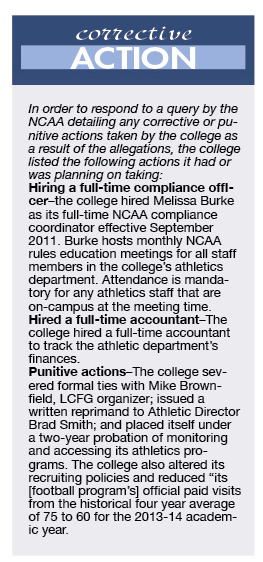
Chadron State College and its former Head Football Coach, Bill O’Boyle, publicly admitted Wednesday to “major” NCAA “infractions” that occurred as early as 2007 and continued through 2011.
The Nebraska State College System posted on its website the college’s 33-page response and O’Boyle’s 25-page response to the NCAA’s “Notice of Allegations” surrounding football fundraising activities and a lack of institutional oversight.
The posting of both documents came five days after The Eagle requested a statement and copies of the college’s response.
The NCAA issued its notice in September 2012, alleging four major policy violations. In addition, the NCAA required that the college and O’Boyle respond by Dec. 17, 2012. After receiving a four-day extension from the NCAA, both submitted responses dated Dec. 21, 2012.
“Our attorney, Scott Tompsett [of Stinson Morrison Hecker, LLP., Kansas City, Mo.], had an extension approved by the NCAA,” NSCS General Counsel and Vice Chancellor for Employee Relations Kristin Petersen said Friday.
The NCAA made four main allegations, each accompanied by from two to six specific alleged violations. Generally, CSC’s and O’Boyle’s statements agreed that violations occurred, but each disagreed with some of the specifics.
The NCAA’s first main point contained six specific allegations of rules violations concerning a lack of institutional control and “impermissible accounts at off-campus financial institutions.”
The college responded that it “agrees that most of the information is substantially correct and agrees that violations occurred.” O’Boyle agreed that a violation occurred, but disagreed, that, despite making deposits and writing checks, he didn’t maintain the “C-Club Account,” one of four accounts involved in the NCAA’s investigation.
The second of the main allegations states that O’Boyle provided misleading information to the institution and that he provided inappropriate benefits to prospective and enrolled student-athletes.
The college agreed that a violation occurred, but noted “the information upon which the allegations are based was gathered during the investigation conducted by the College and the enforcement staff.”
O’Boyle accepted blame for improper recruiting benefits, lack of maintaining supporting documentation, and for the inaccuracy of some of his initial responses. He further stated that he should have fully disclosed all accounts, but disputes the claim that he intentionally provided misleading information.
The third allegation states that O’Boyle failed to promote an atmosphere of NCAA compliance by maintaining impermissible off-campus accounts and depositing the proceeds from the “Last Chance for Glory” golf tournament in those accounts. The college agreed with the NCAA’s statement and noted that it had self-reported the violation.
In the response prepared by his Chadron-based lawyers Crites, Shafer, Connealy, Watson and Patras, O’Boyle acknowledged his use of the “Special,” “Concession,” and “C-Club” off-campus accounts did not comply with NCAA regulations. The response further states, “He [O’Boyle] denies he maintained the ‘C-Club’ account. He denies CSC instructed him to close ‘any and all off-campus accounts.’”
The fourth allegation dealt exclusively with the institution and asserted, among other things, that it failed to provide adequate NCAA rules education, to monitor the off-campus “C-Club” account, and to appropriately monitor football program expenses.
The college disagreed that its NCAA compliance education was inadequate, but agreed that it should have monitored both its football program expenses and the off-campus “C-Club Account.”
CSC’s hearing with the NCAA’s Committee on Infractions is set for Feb. 22 at NCAA headquarters in Indianapolis.
The purpose of the meeting is for the committee to determine what violations occurred and what sanctions might be imposed, Petersen said.
“The committee would decide what infractions were committed, by whom, and what punishment to impose,” Petersen said.
Petersen said the NCAA’s committee decides on a case-by-case basis whether the meeting would be open or closed.
“The committee has the discretion to allow others to attend on a case-to-case basis,” Petersen said. “I believe it [the meeting] is closed.”
In addition to herself and NSCS Chancellor Stan Carpenter, Petersen said CSC President Randy Rhine; former President Janie Park, Athletic Director Brad Smith; Head Football Coach Jay Long; NCAA Compliance Coordinator Melissa Miskimins; Vice President for Administration and Finance Dale Grant; Foundation Executive Director Connie Rasmussen; and Associate Professor of justice studies Jamie Wada, as the faculty representative, will attend the meeting.
Petersen also said that she assumed O’Boyle would also be attending. The Eagle was unable to confirm before press time Wednesday whether O’Boyle will attend.