
Diet affects weight-room outcomes
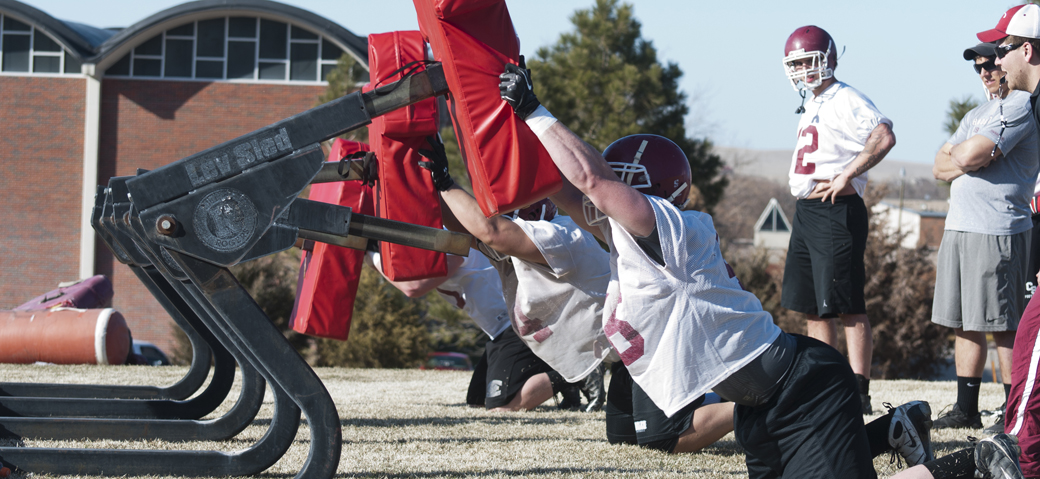
Faster! Go again! Do it right! These are all phrases that the Chadron State football players received during winter conditioning these past few weeks. Through much perspiration, and some vomit, the Eagles football team has made a huge impact already this season.
“Basically, football starts in January with the off-season work outs,” Head Coach Jay Long said.
However, before any of the weights can be lifted or the sprints can be run, the athletes need to prepare their bodies and make sure they are in good nutritional condition.
In order to get the maximum results from a workout, an athlete has to make sure their diet has enough calories to give them energy for workouts.
“For the most part I stress a diet high in calories,”Defensive Coordinator and Strength and Conditioning Coach Jeff Larson said.
Larson said for football players especially, diets with calories are important because of the energy they provide. However, athletes have to be smart about the calories they consume. A candy bar won’t give you the same type of calorie as bread or meat will.
Not only is the kind of food an athlete consumes important, but also when they consume their meals. The standard breakfast, lunch and dinner meals are a necessity for football players, but eating after weight lifting is very important as well. When lifting, the muscles suffer microscopic tears, and need nutrients and rest in order to repair and become stronger.

“I tell the players to eat a decent meal after weight lifting to help their muscles repair themselves,” Larson said. “After a workout, a player’s energy is low, so carbs help transport proteins into the muscle to help repair it.”
During winter conditioning, the football players proved that they had listened to coach Larson’s words as 13 weight lifting records were set, a great way to start spring ball.
“We are extremely excited about the guys’ effort and involvement in the weight room,” Long said.
Jojo Phillips, a junior safety of La Mesa, Calif., led in five of six safety lifting categories, and set a team record in the 40-yard dash, previously held by Danny Woodhead. Phillips ran it in 4.40 seconds, compared to Woodhead’s 4.43.
“Winter conditioning was pretty good, it was still a grind but I was able to push through it and get better,” Phillips said.
Phillips also acknowledges that diet is an important part of sports.
“I eat probably more than six times a day,” Phillips said with a laugh. “I eat a lot of carbs and yogurt, and drink chocolate milk for protein.”
In addition to Phillips records, Conor Casey, junior corner back of Rapid City, S.D., broke the team vertical jump record, held by fellow Rapid City native Allan Schmaltz, with a height of 41 inches.
Lifting his way to the top was Michael Madkins, junior tailback of Elk Grove, Calif., who won the pound for pound lifting category. Daniel Sotelo, sophomore offensive guard of Grand Island, beat the squat record for offensive lineman by 30 pounds from the original one set by Mike Aimone in 2007. Sotelo also led in total pounds lifted for the team with 1,310 out of all core lifts.
“This year’s winter conditioning was more intense than last year because the coaches are trying to fill in spots where people graduated or left,” Sotelo said. “I just want to get better on my footwork and help my team do better than last year because we have the potential to be a really good team.”
Spring practices are every Monday, Wednesday, Friday and Saturday throughout the month of April, ending with the annual spring game on Saturday, April 20 at 10:30 a.m.