
Satirical lines make for a spanking good times
There’s something interesting under the new CSC theatre production. Beneath the comical skivvies of Steve Martin’s “The Underpants”, there hides a witty, satirical romp first written in 1910 by German playwright Carl Sternheim. Martin’s adaptation takes Sternheim’s foundation of mockery and sews in what every modern comedy needs: sex and suffrage. It’s not the right to vote that Martin champion, but rather the right of women to choose.

“It’s the woman’s fault, always.”
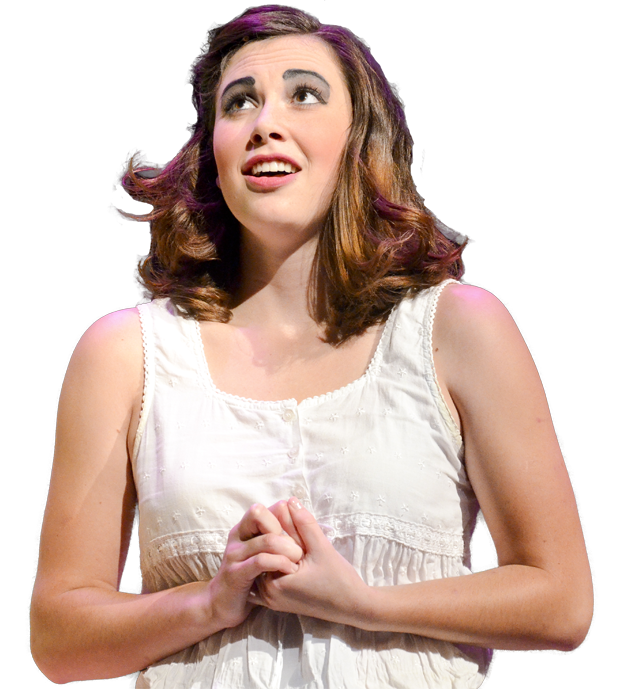
Theo Maske, played by Doug Valade, drops this misogynistic gem while berating his wife, Louise. Her crime is losing her panties during a royal parade. Ashley Daniels plays Louise, the play’s protagonist, who feels trapped in her sexless relationship. After the underwear incident, a series of gentleman come to “rent the couple’s unused room,” which becomes a euphemism for ravishing Loiuse behind her husband’s back. Valade plays the self-obsessed Theo like a negative near-natzi, who constantly browbeats the other cast members. Overly-assertive and greedy, Valade’s Theo makes the audience crawl with indignation. He’s the cretin everyone loves to hate.
Louise dares to dream for something more than her husband, encouraged by her playfully protean neighbor, Gertrude. Sara Labor plays Gertrude’s boisterous bustle like Chaucer’s Wife of Bath, offering sexual advice and abundant humor. As the widow says, she has plenty of “sausages” cooking for Louise.
The prospective meat includes flamboyant Versati, played by Nathan Wojciechowski. Wojciechowski plays the unctuous poet with flare; he and Louise are an enjoyably salacious pair. They constantly play off each other, with little looks and flirtations. This makes the pretense of two plotting adulterers believable.
Wacey Gallagos plays another suitor, Cohen, the reticent Jew. Gallagos plays Cohen as a slight, perfectly nervous hypochondriac. He keeps Cohen interesting, acknowledging the man’s deeper motivations, while running the line between sweetheart and stalker
As the third suitor, Ryan Steinhour commands the stage with his stature and precision, playing the uber-proper Klinglehoff. Steinhour tackles a German accent for this show, gamely swapping his consonants and huffing through his large mustache. Occasionally Steinhour slips in his Germanic lilt, but the over-all effect is hilarious.
An exaggerated set and makeup design retain the turn-of-the-century farce, and the actors mix in melodrama with hat-tips toward political and social commentary. With Martin’s script and the actors’ energy, the CSC theatre department has created a downright intelligent mockery of patriarchy and sex, elevating the play from goof to spoof.
As the play progresses, Daniel’s Louise turns from a naïve victim to a canny manipulator. Wojciechowski hones his part as the Byronic lover, Labor’s give Gertrude some refreshing morality, and the battle between realism and idealism leaves the underpants, and the audience, in stitches.
The play is not without its touching moment, though. When all seems lost, and Louise’s hope of a magical affair is burnt up faster than her over-cooked wieners, Dainels reminds the audience of the crushing domestic walls women faced during that time. During this moment, Gallegos also brings the sensitivity he polished in last year’s production of Almost Maine. He and Daniels, who were paired during the Spring show, use a small, sensitive scene to ground the rollicking farce. Daniels takes a moment which could have been about a pouting adulteress, and turns it into the deep disappointment anyone dreamer can relate to.
Finally, the German king visits the Maske household, played by Nicoli Poitra. Poitra is a perfectly-oiled monarch, whose two-minute scene reinforces the old acting adage: there are no small parts, only small actors. Poitra’s pomp and grandiose attitude reflect the entire patriarchal tone of the play. Whether it’s the lusty Versati or the deliciously over-bearing Theo, none of the guys understand Louise. She doesn’t necessarily want an affair, she wants the option to pick her lovers. She wants what, according to Chaucer’s Wife of Bath, all women want – the power to choose. With a warp of melodrama and a weft of satire, the underpants weaves a sturdy pair of narrative knickers that with have you laughing your own pants off.