
Telling war stories is never easy
It is tough to strike a balance between considering your listener (or in this case, reader), and saying what you really need to say.
 I was invited to sit on a panel of Veterans last Thursday for an FYI class, “Virtue and the Warrior Spirit,” taught by English and Humanities Professors Kathleen Bahr and Brad Wilburn.
The panel consisted of Tim Donahue, Vietnam Vet and Professor of Marketing and Entrepreneurship; Franklin Annis, Iraq Vet with the Nebraska National Guard; John Noonan, Air Force Vet and CSC senior; and myself, Afghanistan Vet and former Marine.
I walked into the classroom expecting to lend some insight to the students, but I walked out questioning myself. The struggle I face when recounting my experience is to not come across as having a chip on my shoulder.
For me, the necessity to maintain a semblance of humility supersedes communicating what I feel needs to be said. There’s a duality in that statement that cultivates a certain neurotic attitude, with the bulk of my cognitive dissonance stemming from two considerations.
The first consideration comes from a conversation I had with Ron Hull after he spoke to the media writing class my freshman year. Hull is one of the founding fathers of Nebraska Educational Television, and is a compelling story teller, so I had asked him for advice.
“You have to not waste a person’s time when you tell a story,” Hull said. “Time is the most valuable thing people have, it’s literally their life.”
The second consideration comes from author E. B. White. White revised William Strunk Jr.’s “Elements of Style,” and wrote several children’s books, including “Charlotte’s Web,” and “Stuart Little.”
White often said that a writer’s obligation is “to lift people up, not lower them down.”
My juxtaposition to that statement: the iconic Marine recruiting poster with the tagline, “We don’t promise you a rose garden.” 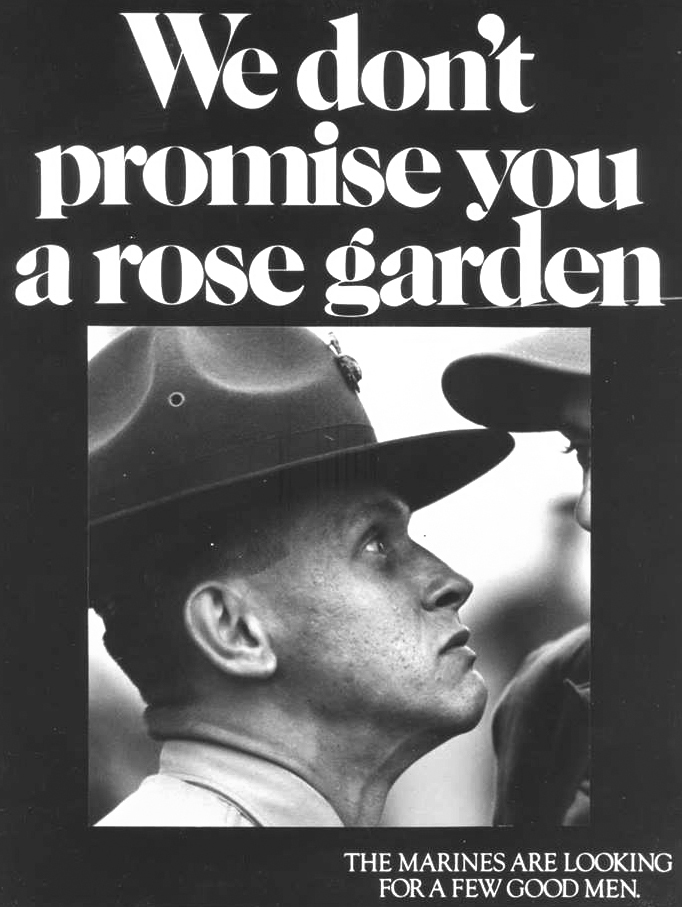
That is certainly truth in advertising, and due to my experience as a Marine, it’s challenging to paint a chipper picture of my service. That’s probably the main reason why I switched from Public Relations to Journalism.
After living five years of bleak reality, I’ve become accustomed to dismissing the silver linings.
Having a positive outlook helps a person’s disposition, but the practice serves to avoid problems rather than solve them, and in a combat environment, problems are plentiful and require immediate attention.
If I try to write with a positive or promotional bias, it feels plastic, forced, and insincere. I don’t want to be a sycophantic cheerleader that makes people feel good about doing nothing. My message is the truth: the more brutal, the better.
But what holds me back in that regard is that I’ve witnessed my friends adopt a similar condescending attitude once they received their honorable discharge.
“While these 19-year-old punks were getting drunk and getting laid; I was in Afghanistan praying that I wouldn’t get my [genitals] blown off.”
That is a line I’ve read too many times, and while it’s honest, it’s hardly fair or uplifting.
Our society no longer maintains an understanding of war (and those who fight it), because the same freedom that allowed us to volunteer gives civilians the freedom to tune it out.
That problem is recursive in nature because those very freedoms have been afforded by the virtue of voluntary sacrifice, an experience for which a comprehensive and intimate understanding seems to be exclusive to the volunteer.
I used to think that suffering in silence allowed me to present myself as “well adjusted,” avoiding the stereotype of the disgruntled and jaded Veteran. I still can’t justify saddling even my closest friends or family with the stories I really want to tell.
It’s the day and age of choice; I chose, and they didn’t. I have to respect their choice, and I think it is expected that I ask for nothing in return.
While I feel I have earned some degree of consideration or at the very least, empathy; I’ll never be comfortable having to ask for it, because that very act makes me vulnerable to unwarranted criticism.
On a several occasions, I’ve had people imply that I’m a drain on the tax-payer and I’ve been summarily dismissed as a whiney and entitled Millenial.
I’m wise enough to know now that appealing to guilt trips to spark action or engage interest is a fruitless pursuit. That tactic only wastes people’s time and makes a message prone to being ignored. When that happens, it invalidates the reason why I’m here today.
I went to war as part of the Nintendo generation combating an ambiguous foe, rather than having engaged in “the good fight” against a defined enemy.
I feel guilty knowing that I came back in one piece while 6,774 of my comrades were not so lucky.
I have a hard time knowing that millions more are still living but are hardly alive; VA hospitals overflow with the wounded, our streets are filled with the homeless, and on a daily basis there is an average 22 Veterans that commit suicide.
Because I made it out alive, I owe those fallen and injured service members my talents to draw attention to these issues. My life is a debt that I can never repay, and because of that debt I suffer from a crushing fear.
That I too will be ignored.