
Audience treated to hilarious and heartfelt concert
Last Sunday, CSC’s Men’s Ensemble and Arioso, the women’s ensemble, named after an Italian opera term, performed at the Chadron Arts Center, and they brought a few surprises. Specifically, the two conductors Joel Schreuder and Una Taylor included African drums, dancing, Raga, and underwear in the evening’s performance.
Show patrons anticipated beautiful, solemn pieces, with centuries-old pomp to match the Arts Center’s stained-glass sanctuary. The two ensembles satisfied this expectation with graceful tones, and they performed their wistful songs with trademark elegance. For instance, the Men’s Ensemble started their set with “Innisfree,” composed by Bradley Ellingboe and based on W.B. Yeats’ famous poem. Featuring a solo by Scott Reffert, baccalaureate of Omaha, the song flowed through harmonies smoother than the waters of that idyllic isle, Innisfree.

The ensemble followed this with a Barnum composition, also based on a famous poem, this time by Robert Burns. But after these two refined pieces, the shenanigans began, with Kimberly Murphy manning the piano. The Men’s Ensemble sang “Pirate Song” by Tim Y. Jones, which included such lines as “my pirate isn’t snooty, my pirate shakes his booty.”
The men sang their ridiculous nautical lyrics so seriously; they left the audience in a sea of laughter. Of course, the men ended this song in the only way fitting. They struck Captain Morgan poses, and as the last piano strains faded away, they all whispered “arrrrrr.”
Turning on a dime, the men then sang a calm Latin invocation, which asked God for peace. The audience responded to this order, quieting themselves, only to burst out laughing once more at the next piece. Schreuder introduced Joelle Keith, sophomore of Sterling, Colo., who strutted out in a large polka-dot dress, and called her Patsy Cline. The men formed an arc behind her, and as Keith belted Hank Cochran’s “She’s Got You,” the ensemble swayed and sang backup. The men were upstaged though, as Keith reached into her dress and pulled out a photograph. Then she pulled out a record, and then another record, and another, and another, throwing them onto the floor with flippant ease as she sang, “I’ve got all these, but she’s got you.” More records followed. Then came three shot-bottles, one of which Keith drank. By the time Keith pulled a full-sized golf putter out of her dress, the audience was in stitches. A green pair of Hanes completed the act, and as ensemble members bowed and cleared away the detritus, the audience was still laughing.
The Men’s Ensemble followed this song with “Goodbye, Then,” a piece which matched the previous one in theme, but not levity. Complimented by Pamela Shuler on clarinet, this piece quickly changed the concert’s tone from tickled to tragic. The difference between these two “break-up songs” emphasized that under every joke lies true emotion. The ensemble concluded their session with “Ramkali,” an Indian Raga. A “Raga” is a melodic mode used in Indian classical music. Schreuder explained it as: “we are imitating instruments from India, along with overtone singing.” The effect was hypnotic. In Sanskrit, “Raga” means “to color or dye.” Following this mentality, the ensemble controlled a wide array of vocal shades, all combining for an upbeat spectacle.
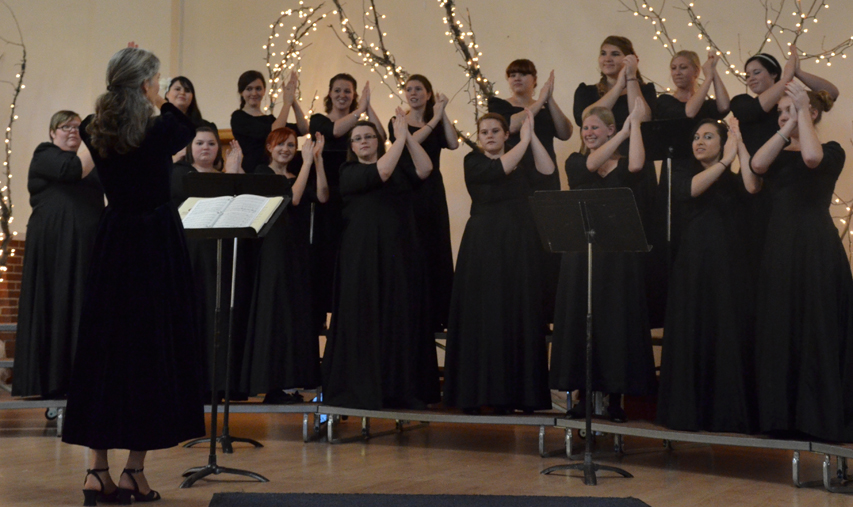
Not to be outdone by their male counterparts, Arioso began their set by marching up the aisle, singing “And She Will Rise,” an empowering Pagan chant, arranged by Dakota Butterfield. Kimberly Murphy, percussionist for the entering song, stayed at her drum for the next piece. “Cancion De Los Tsachilas,” a traditional Ecuador song, praises the women who prepare “chicha,” a fermented corn drink. Arioso opened that piece with a peaceful slew of nature sounds, imitating the wind and birds. After this piece, Taylor prefaced by pointing out that the next song, “Nada de turbe,” was both written and arranged by a woman. Taylor said Arioso is about “celebrating women and children.” The rest of the ensemble’s pieces followed this theme, incorporating such choral favorites as “Prayer of the Children.”
The concert’s tempo picked up as the woman broke into syncopated clapping, and they sang “El Vito,” a dancing song from the south of Spain. Chantel Sullivan, senior of Mullen, soloed, and the chorus looked pleased to have successfully navigated the challenging piece.
Finally, Arioso sang “We Rise Again,” framing their concert’s original theme of rising and female empowerment. At the piece’s close, the whole choir stepped off the bleachers to join soloists Dara Edwards, junior of North Platte, and Mariah Rader, junior of Gering, as they finished strong. Such uncharacteristic drama on Taylor’s part added energy and momentum to the concert, and the set culminated to a powerful close.
I was very surprised with the Men’s Ensemble’s and Arioso’s concert, both for the laughs, and the potent emotions they supplied. While never devoid of class and talent, the two groups had fun while they performed, ensuring the watching audience did the same.
Video of the full concert: