

At 90, artist proves age is just a number
Some people are just late bloomers. Van Gogh’s first exhibit showed when he was 39. Cezanne created his fame-gaining pieces only years before he turned 66. At age 74, Michelangelo painted the ceiling of the Sistine Chapel.
Myra Omelanuk would blush at being placed in such company. First, because she is a modest woman. She would not call herself Van Gogh. Second, because although Omelanuk will turn 90 January 30, she has been blooming her whole life.
If flowers equate to artistic production, then 70 years’ worth of blossoms belong to Omelanuk. Tonight, though, just a pink rose adorns her lapel. Friends and family eat pink-frosted cake and congratulate Omelanuk. Nearby, her two daughters, beam with pride. It is Omelanuk’s art reception and birthday party, in the lobby of Memorial Hall. Upstairs, in gallery 239, a bouquet of her works will be displayed until Feb. 5.
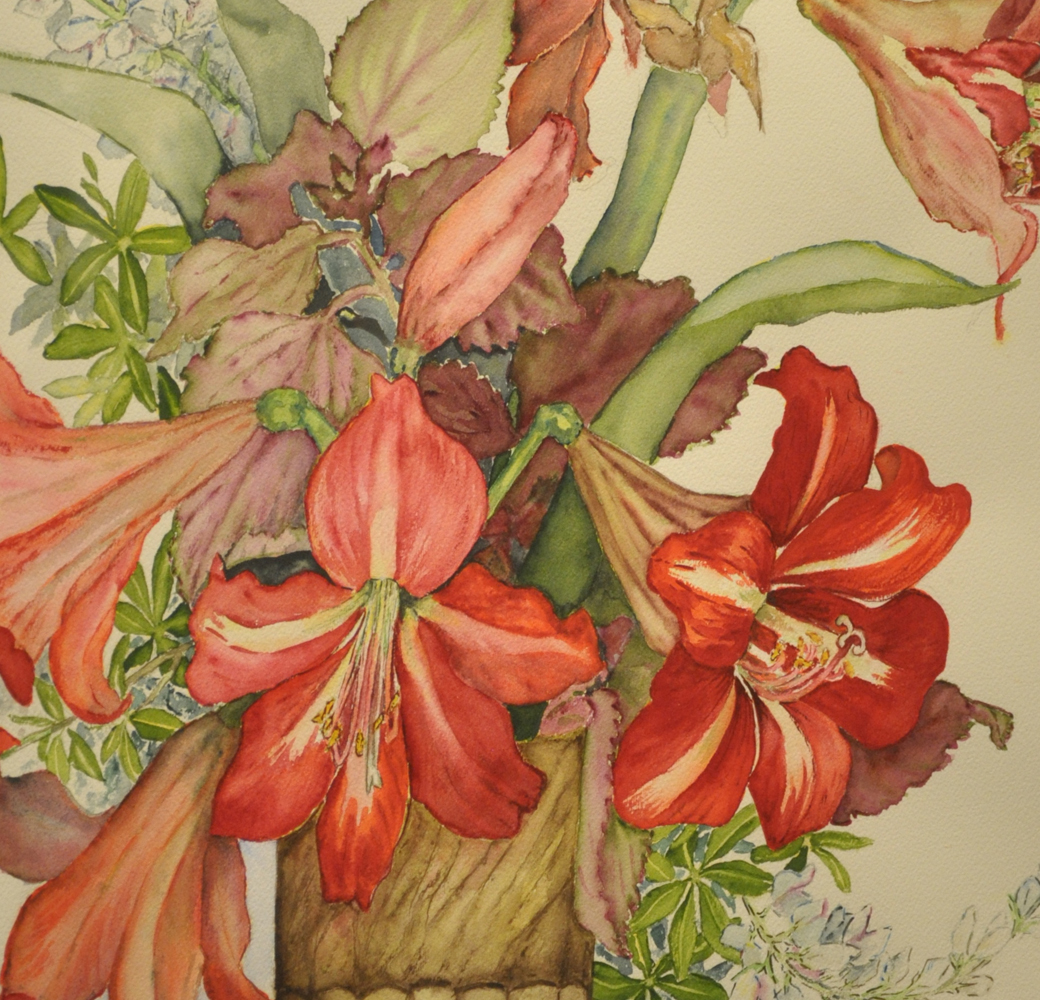
The cozy gallery is bursting with ornamental peonies and irises, all of which are preserved with Omelanuk’s brush. She only paints live flowers, which she often grows herself. She finds them more attractive models than their photographed, 2-D counterparts. Perhaps it is this commitment to first-hand painting, or Omelanuk’s trained hand, but the pieces are startlingly life-like.
Like petals in nature, Omelanuk’s blooms spill their colors in a gush from base to lip. Her irises are not purple, they are indigo, violet, fuchsia, lavender, and lilac, all in the space of one brush stroke. Omelanuk’s color spectrum vitalizes her work, which is important in such a broad category as “flower paintings.”
Students may be leery to investigate the senior’s work, assuming her creations to be for “older” audiences. This couldn’t be further from the truth. In fact, student could learn much from the near-centenarian’s work.
Omelanuk’s paintings are colorful, yes. “Pink Irises”, for instance, is packed with pigment, and the rosey tones do justice to Mother Nature’s own pen. But Omelanuk’s work is not undisciplined.
Unlike more modern, splash-n-dash paintings, Omelanuk’s watercolors are careful and controlled. The paint is contained in outlines and borders, lending the flowers a paper-pressed realism. Instead of dramatic, conceptual flowers, Omelanuk’s pansies and irises are real, or as real as she can make them.
The clear patients and planning each piece must have taken begs a second glance from viewers. The pencil flower’s detail, lost when viewed from afar, might escape some students. Much like everyday life, you must get closer to Omelanuk’s works see their amazing beauty.
“It’s like you can just touch it!” Judy Goff exclaims, as she examines Mauve Iris, a watercolor Omelenuk painted in 2009. Goff, a Chadron resident, stands beside fellow reception Russ Seyer.
“The irises are wonderful,” Seyer agrees. He is a friend of Omelanuk’s, and has seen some of these same pieces hanging in her home.
“It’s a joy to have them here,” he says, as he looks around the gallery. Omelanuk’s presence in Chadron has grown her both a garden of friends and flowers. Kit Watson has known her for over 20 years. Watson, who used to teach art at CSC, once lead a figure drawing group on campus. There, Omelanuk and her friends practiced sketching the human form.
“She always laughed,” Watson says, of her time with Omelanuk during figure drawing. Standing in the softly-lit gallery, Watson looks around at Omelanuk’s many blooms. A bursting set of peonies spring from their canvas, and to her left, an ornamental orange iris glows like a sunset. “I think she is very humble of her work,” Watson says, “and she does beautiful work.”