
Detail defines Native American artist
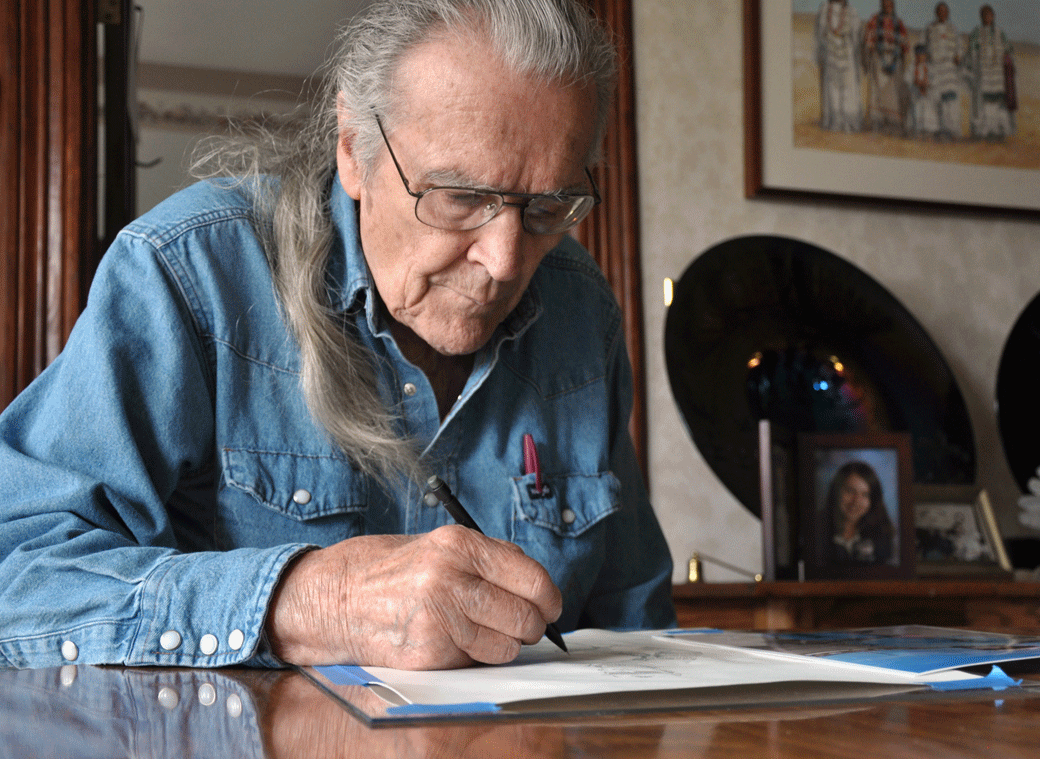
In the 1950s, the era when abstract art was taking hold, a master in photo-realism was finding his way, working to achieve an artistic identity while preserving his own style. An art professor once told him he could never be a painter because of his love of detail. That same professor then led him upstairs to a classroom where telephones, radios and automobiles were being drawn in an industrial design course.
“This is where you belong,” the instructor said to Don Ruleaux, a nationally known Native American artist born in Martin, South Dakota, on June 19, 1931. Ruleaux’s great grandfather was a fur trapper from Canada who married a woman from the Ogalala Sioux Indian Tribe.
Ruleaux, now 82, grew up in Pine Ridge, South Dakota, and when he was about nine years old the family moved to Gordon, where his father worked as a cook. Neither place was suitable for cultivating his artistic talent.
“They didn’t teach art in public school when I was in school,” Ruleaux said.
“They considered it a waste of time to do that. But I did a lot on my own because I liked it. When I was little, in grade school in Gordon, I used to copy comic characters. I would also check out books from the library with really nice pictures and copy them.”
Ruleaux’s interest in drawing continued throughout high school. He poured over the artwork inside books he checked from the school library. Once a week, he and a small band of his classmates were permitted to go to an empty classroom and draw.
After graduating high school in 1950, Ruleaux worked for the U.S. Geological Survey as a “rodman,” working south of Gordon and Valentine. Ruleaux later transferred to Rolla, Missouri, where he trained as a cartographer.
In 1952, facing the draft for the Korean Conflict, Ruleaux enlisted in the Navy and put his cartographic training to use. He served on three ships, The Piedmont, and The Fletcher and The Perkins, the latter two were combat destroyers. Ruleaux’s time in the Navy took him to Korea, China, Japan and the Philippines. With only six weeks remaining in a three-year tour, Ruleaux was transferred to the USS Ammen. He earned an early discharge and returned home before Christmas.
“So, I came back and I could have gone back to my job,” he said, “but guess what? I had gotten married while I was in the Navy. Well, Betty, after we married, found out about my interest in art. She wanted me to go to college and study art, I wanted to go back to Rolla, Missouri, but she kept insisting that I go to college.”
Taking his first art class when he was 25, Ruleaux, his wife Betty, and the first of their six children, Frank, moved to Chadron in 1956. There, Ruleaux enrolled in his first art class at Chadron State College. However, back then the college did not offer a degree in art, so the Ruleauxs packed their belongings and moved to Kansas City, Missouri, where he enrolled in the Kansas City Institute of Art. Before leaving Chadron State, Ruleaux’s watercolor instructor questioned how the instructors at Kansas City Institute of Art would view his love of detail.
“Do you think they’re going to let you use little brushes at the Kansas City Institute of Art’” Ruleaux said, imitating his instructor.
It was the art instructor at Kansas City who escorted Ruleaux to the industrial design class.
“I didn’t pay much attention to what they said,” Ruleaux said. “I just kept doing what I was doing.”
But pessimism from art instructors was not his only obstacle – money, or the lack of it, hampered his education.
“Things were getting pretty tough financially,” he said. “My art professor tried to get me a scholarship for the second semester, but it didn’t work out. I finished that semester and took a job.”
Ruleaux worked for the Bemis Brothers Bag Company, designing images printed on the bags. But Betty pushed back, and her persistence prompted Ruleaux’s return to college. After working for Bemis Bag Company for eight months Ruleaux moved his family back to Chadron and CSC. After returning, Ruleaux met Dr. William E. Artis, the man instrumental in convincing Ruleaux to become a teacher.
“Dr. Artis talked to me and said, I should go into teaching,” Ruleaux, said. “He told me ‘remember, you have to have food, clothing and lodging. If you are teaching you get paid every month; you do your art on the side. If you get good enough to make a living off of your art, you stop teaching and do your art.’”
Ruleaux graduated from Chadron State College in 1959 with a bachelor’s degree in art education. Nine years later, in 1968 he earned a master’s degree in art education at Arizona State University, Tempe.
Ruleaux’s first teaching job was in Gering, during a time of strict dress codes that included short hair for men.
“I had long hair and I wouldn’t get a haircut,” Ruleaux said.
Student’s parents would call the administration complaining about Ruleaux’s long hair. The principal back then supported Ruleaux’s rebellious stance.
“He is an art teacher from France and they have different customs,’” Ruleaux said the principal used to tell callers. “When he’s been here long enough, I’m sure he’ll do the same as all American men.’ The closest I’ve been to France is Omaha.”
After leaving Gering, Ruleaux and his family moved to Spearfish, South Dakota, where he spent the next 24 years teaching.
After retiring from teaching in Spearfish, Ruleaux decided to return to teaching, this time spending six-and-a-half years in Curtis and Hastings.
The next move took the Ruleaux’s back to Spearfish.
During Ruleaux’s years of teaching and earning his degrees he and his wife were busy raising their six children: Frank, Donald, Mary, Francelia, Beau, and Robert.
It took Ruleaux nearly 32 years to kick-start his art career.
“I worked pretty much full-time in the summer time too,” he said.
“Of course I went fishing a lot; and deer hunting in the fall; and then down at The Old Style. So I really didn’t get that serious until they started Tribal Arts in 1988 or 1989.”
Tribal Arts was a juried art show held in Sioux Falls, South Dakota, in which Ruleaux received an award for 15 consecutive years 1988-2003.
Working in his predominate genre of Western and Native American art, Ruleaux has various oil paintings, silver points, watercolors and sculptures displayed in the Museum of Nebraska Art, Kearney; the Peoria (Illinois) Riverfront Museum; the Atka Lakota Museum & Cultural Center, Chamberlain, South Dakota; the Dahl Arts Center, Rapid City, South Dakota; and the Heritage Center at Red Cloud Indian School, Pine Ridge. He also has a piece hanging in Memorial Hall’s Lobby
Ruleaux’s skill at capturing detail led to a unique opportunity. The art director of the movie, “Lakota Women: Siege at Wounded Knee,” called Ruleaux, offering him a job as a draftsman-artist, drawing blueprints of various locations and images needed to construct the sets for the film.
He also painted some of the buildings on the set.
Afterward, Ruleaux and his wife returned to Chadron.
“The fall of 1999, here I was again a student at Chadron State College,” he said.
Ruleaux was offered a position at CSC teaching “art for the Elementary Teacher,” which he accepted. Ruleaux taught at CSC until 2010.
“I was just an average teacher,” he said in his signature humble way.
Average, however, is not how those know him best at CSC, describe him.
In 2012, after more than 40 years of teaching, the art department at Chadron State nominated Ruleaux for the Nebraska Governor’s Arts Award.
Ruleaux was one of two people who earned the award for Excellence in Arts Education.
“He’s played a big part in the art department the last 15 years,” Richard Bird, professor of visual and performing arts, said. “He is more than eager to come up and help students.”
Over the past 15 years, Bird said Ruleaux has donated four to five paintings to help the CSC Rodeo Club raise funds.
“There’s not an artist that can portray western images like Don, all with a silver pencil,” Rodeo Coach Dustin Luper said.
“He’s so down-to-earth. It’s never been about money to him, but about what he can leave to spur the next generation on. He’s been a great asset to Chadron State College,” Luper said.
This man started My Inspiration and has always been in my Heart ! Such a wonderful man and Great teacher!!! Thank You!!!!
Don, you were the kindest, gentlest teacher ever. And such an inspiration. I really liked your classes and you were an inspiration to me. Glad I got a chance to read your about your journey in art and teaching. God bless
As my art teacher in highschool, this man gave me a true passion for art! A true inspiration to me and many others! An amazing man!!! My art guru!
Ate Ruleaux, I was never officially assigned to your art class at LHS. I use to sneak in and you let me stay. By accident I learned about the world of art and how to use it in my life. You can bet I’ll travel to Kearney, Nebraska to view your work. Pilamaya