
Semester’s end brings era’s end
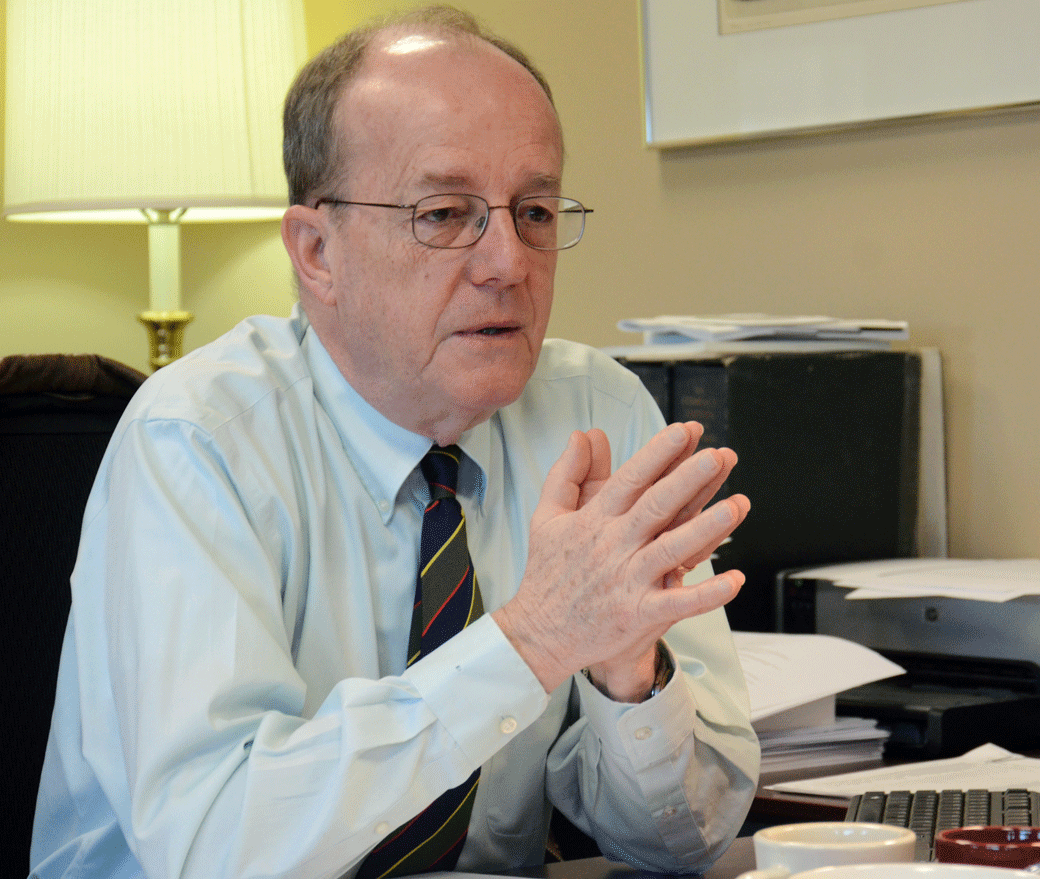
George Griffith is leaving the business of explaining. After 39 years of clarifying the mysteries of literature to his students, Griffith is retiring from his post as a professor of English and humanities at Chadron State College.
Griffith started at Chadron in 1975, after receiving his Ph.D. From Southern Illinois University.
“The mid-seventies were a tough time to get a job in higher ed,” Griffith said of his initial job-hunt. “When there were fewer people entering school, there were more and more people qualified to teach it.”
This lead Griffith to apply to CSC for a position that required a teacher of both speech and English.
“I said to myself, ‘ah, I can teach speech,’ so I applied,” Griffith said.
He could, in fact, teach speech, and after his interview, Griffith was offered the job that day. With a beginning salary of $13,710, Griffith moved to Chadron with his wife Maggie.
Many years later, much has changed. In Griffith’s eyes, the computer revolutionized teaching the most. Instead of the typewriter and mimeograph machine, the original tools of Griffith’s trade, he can now email papers, save drafts, and call up photos of Wordsworth’s cottage faster than you can say “Tintern Abby.”
“I’m the last faculty member here who did a dissertation on a typewriter,” Griffith said. His dissertation, a 300 page investigation of “The Idea of Progress in the Fiction of George Elliot” combined two of Griffith’s loves: Victorian author George Elliot, and the history of ideas. As a teacher, Griffith’s natural territory is in ideas, whether those are literary or ethical.
Griffith teaches one of the oldest, wholly-online courses at the college, his ethics course, in which he once impersonated a student in the forums. The faux student would make outrageous claims, and at the end of the semester Griffith revealed to his students the identity of their inflammatory classmate. Their final discussion question: “was it ethical to pretend to be a student?”
Despite being one of the first professors at CSC to work online, Griffith has mixed feelings about the format.
“The computer, for the most part, has done wonderful things for the profession,” Griffith said. The less-than-wonderful aspects, Griffith said, are online classes.
“These classes can tempt our lesser angels, both students and faculty.” Griffith said. “It makes it easy to be lazy.”
The online class format also promotes an aspect of higher education Griffith said he will not miss: adjunct faculty.
“They’re not paid well and they don’t get the feeling of belonging to an institution, so they want to do as little as possible,” Griffith said. “This appeals to the lazier students who say, ‘well I’d like to do as little as possible as well.’”
The proliferation of part-time distance faculty also breeds, in Griffith’s eyes, more bureaucratic administration. “I understand that a certain amount of that is necessary,” Griffith said, “but nobody has ever learned anything is a dean’s office.”
The faculty, even in the English office, is substantially smaller than when Griffith joined CSC, even though the student body has grown. Administration has also grown.
“It’s very discouraging,” Griffith said. “Were it not for that, I wouldn’t stop. I love teaching. It’s so much fun.”
Griffith first fell in love with English in the ninth-grade classroom of his Catholic high school.
“They had, by today’s standards, a huge reading program.” Griffith said. The nuns were stern, but Griffith soon found they didn’t have to make him read; he loved it. Griffith struggles to find the same love in most students. Today’s poorly-read students concern him.
“That, more than anything, saddens me to this day,” Griffith said.
He believes he read as many books in one year as many students do in four years. It was during these high school years Griffith discovered one of his favorite novels, Jane Austen’s Pride and Prejudice.
“Every time I do English and American Novels, I say ‘I’m not going to do Pride & Prejudice.’” Griffith said. He has taught the novel every time.
“It’s like going to the amusement park and not riding the roller coaster,” Griffith said. “Of course you’re going to ride the roller coaster.”
As for the roller coaster of teaching, Griffith withholds giving advice. He says new teachers will know, right away, if it’s for them. The first time Griffith taught, as a TA at Southern Illinois University, he was only four years older than his students.
“It was terrifying,” he said.
Now, a larger generation gap separates Griffith from his students. However, this hasn’t stopped him from becoming one of the student’s favorites.
“Dr. Griffith’s classes were one of the reasons I loved studying English at CSC,” Kelsey Amos, 2012 graduate said. “After all, it takes skill to turn sentence diagramming into an art form.”
According to Con Marshall, of information services, Griffith is the fourth-longest tenured professor ever to retire from CSC.
In their time, Griffith knew Barton Kline, after whom the now-demolished Kline center was named, Ava and Edwin Nelson, of the Nelson Physical Activity center, in addition to Ross Armstrong, Donald Burkhiser, and the library’s own Rita King.
“I sometimes amuse myself by thinking about how many people I know after whom buildings are named,” Griffith said.
He has seen many of these buildings built, and watched as the campus, and the campus’s flora, have grown.
“It’s much prettier now,” Griffith said, as he looked out his office window on the second floor of Old Admin.
Griffith himself suggested the name “Old Admin” for the previous administration building. During the building’s repurposing from administration to classrooms, the Dean solicited new name ideas from the faculty.
“I suggested that what was needed was a name that would reflect the change but not abandon the history,” Griffith said. “Hence, Old Admin.”
“Teaching is a joyful profession,” Griffith said during his interview. He has found infinite joy in his years a CSC, and he is sad to leave. Once retired, Griffith and his wife will move to Idaho. Of his retirement plains, Griffith said, “I’m going to resurrect my golf game. I will do what I enjoy doing now, gardening, cooking, and reading.”
Without Griffith, students will have to seek their British literature elsewhere, and may be bereft of sound advice like “writing is like jazz, there’s always room for improvisation.”
Nikki Highfill, soon-to-be graduate of English education, keeps one piece of sage Griffonian advice close at hand. “Dr. G. taught me that when one chapter ends in life or in a book, a new one is always waiting to be discovered.”
As Griffith prepares to close the cover on his time here at CSC, he is both excited and sad.
“It’s bittersweet,” Griffith said. “I am interested in discovering the new part of my life, but I am going to miss being the village explainer.”