
ROTC teaches students leadership skills, military techniques
Humid summer air creates a thick blanket of sweat on the forehead, which pools to other parts of the body, but there is no escape from the heat. The men and women are dressed head to toe in crisp, camouflage suits, creating a vacuum for heat, but there is no complaining about the boiling rays from the sun.
Wednesday’s are devoted to ROTC Lab, a class that trains young men and women about the duties and responsibilities of a soldier. They obtain the knowledge of not only what it takes to be the best soldier they can, but also of the world, military, and leadership.
First Sergeant for the CSC ROTC Program Kassie VanDiest, 20, junior of Dunning, and Platoon Sergeant Major Armstead, 21, junior of Los Angeles, led the Sept. 3 lab. VanDiest called for everyone to fall into formation, which ended with three long lines of freshman and veteran ROTC members.
“We were conducting a D&C [drill and ceremony] lab, which is basically working on marching,” VanDiest stated. “We broke up into small groups and did classes on facing movement, the proper way to handle a rifle, and formation procedure.”
VanDiest lead the squad that taught ROTC members facing movements including standing at attention, which is when they stand facing forward, hands straight down at sides, in an alert position. They also learned at ease and rest position, which is a little more relaxed than the attention position, but they still keep their backs straight, and focus on the person giving the information.
Megan McLean, 20, sophomore of Brewster, led the squad that showed students how to properly address an officer with hand and body movements. Keeping the right arm straight, they should bring their hand to the brim of their hat, keeping their arm at a 90 degree angle from their body. Their thumb should be tucked into the hand while in this position.
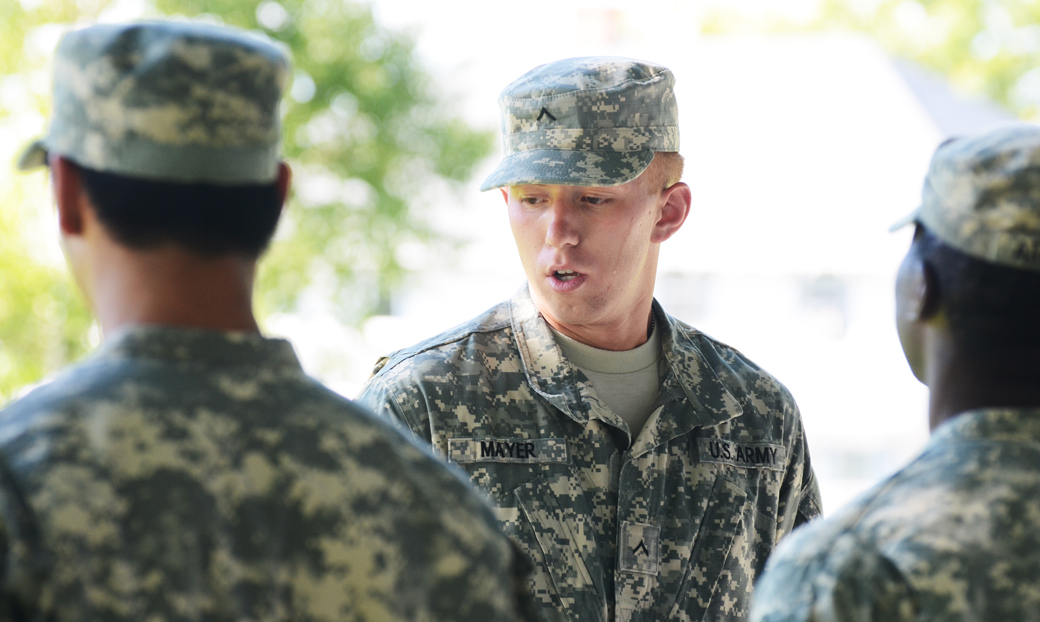
“It’s a snap; it’s not going to be slow,” Caleb Geiger, 19, sophomore of Cozad.
Another squad was teaching cadets how to properly hold a rifle, and the proper stance, while shooting it. Have an athletic stance, with a straight back, knees bent, and the butt of the gun level to the lower chest. Squaring up the shoulders is important because it keeps the upper part of the body straight, leaving less chance of being shot in the sides of the chest or stomach.
The last squad taught students how to properly march in a group. When marching, a person should always start off on the left foot. When the group halts, they should continue to march in place for three steps, with their arms still moving, before they cease movement.
ROTC teaches students a number of things including, but not limited to, military rank structures, tactics, leader development skills, and about weapons. They also focus on current events such as ISIS, and last year they focused on the Sochi Olympics because of what was happening there, and where Sochi was located on a map; how to land navigate using only a compass and a map; how to march properly; and it teaches them to develop a basic knowledge of the world and the military.
“It’s really time consuming but it’s worth it. I learned a lot and they taught me well,” Andrew Cameron, 23, CSC graduate student, 2nd Lieutenant in Fremont, said. “It’s a good program if you want to do anything in the military.”
ROTC also gives them an opportunity to study abroad, learn a new language, and work with national guard units. This past summer, seven cadets went to the Leadership Development and Assessment Course, which is the equivalent to ROTC, and completed it.
Other summer adventures included McLean, who went to the United States Army Airborne school for three weeks, where she had to jump out of a plane. The first week is ground week, where they took an Army Physical Fitness Test, and practiced how to properly exit an aircraft. The same techniques were used to jump out of a 34-foot tower, she said. Participants also learned how to perform a proper parachute landing fall off of the lateral drift apparatus.
The second week was tower week, where they practiced mass exit techniques out of a mock door on the tower. They also perfected their PLFs on a 12-foot swing landing trainer, and practiced how to steer away from other parachuters, using the suspended harness. The final week was jump week, which involved all participants to jump out of an airplane after harnessing themselves, and then being inspected by the jump master, McLean said.
“When the door opened, and everyone began jumping out the door it felt completely different from everything we had done to prepare for it,” McLean said. “When I jumped out it was chaotic for a few seconds but after my static line deployed my parachute and I slowed down, I really enjoyed myself.”
She said that, even though she was scared of heights, riding the parachute down was her favorite part.
“Overall, I enjoyed my experience there,” she said. “I got to meet some really interesting people from all corners of the nation, and made some good friends. I also got to do something I never expected to.”
Executive Officer for the Mount Rushmore Battalion, James Barrows, 22, senior of Chadron, was able to attend the Cadet Troop Leader Training and Project O this past summer. There, he was able to work with live fire and troops, while learning about tanks and how to direct them. Barrows went to Kansas for a month and a half. He learned Arabic in Kansas for the project. The first year of the project is an in-state at a campus, while the second year is a study abroad portion. Barrows also attended Cadet Troop Leader Training for two and a half weeks at Fort Carson, Colorado Springs, Colorado. He was able to shadow and be a platoon leader for the 138th infantry. Barrows was also a platoon leader for a Bradley Platoon.
“There was artillery, air support, and engineers,” Barrows said.
“There are 50 people total in ROTC,” Nathan Reicks assistant professor for ROTC said.
Twenty of which are incoming freshman; however, there are almost 30 new incoming students.
“This is the biggest class by far,” Reicks said, “The program is growing and hopefully it continues that way.”