
Peace pipes represent past
Pipemaker Rick Hull spoke on his experience building pipes and their deep spiritual meaning to Native American tribes. The CSC diversity committee sponsored the event.
“The pipes are like my children. Once you spend so much time on them it’s hard not to be attached,” Hull said of his work. This may sound excessive, but it can take 450 or more hours to create a single pipe, and that is after the stone has been pulled from the ground. With more than 25 years of experience, it is no wonder Hull is so invested.
To Native Americans, the pipe is one of the most sacred objects in their culture. They believe the pipe to be the blood and body of their ancestors, and from smoking out of the pipe they communicate directly with the great creator.
Hull is a member of the Keepers of the Sacred Tradition of Pipemaking. The goal of the organization is to preserve Native American history, culture, and aide current natives in need. The group currently has a program to allow incarcerated Native Americans the use of a peace pipe for religious ceremonies. Hull reported that in instances where these inmates are allowed to use a pipe, their rate of being incarcerated again has been reduced by more than 50 percent. According to a New York Times article in 2013, it costs more then $150,000 tax dollars per year per inmate. In this sense, Hull’s work is community service.
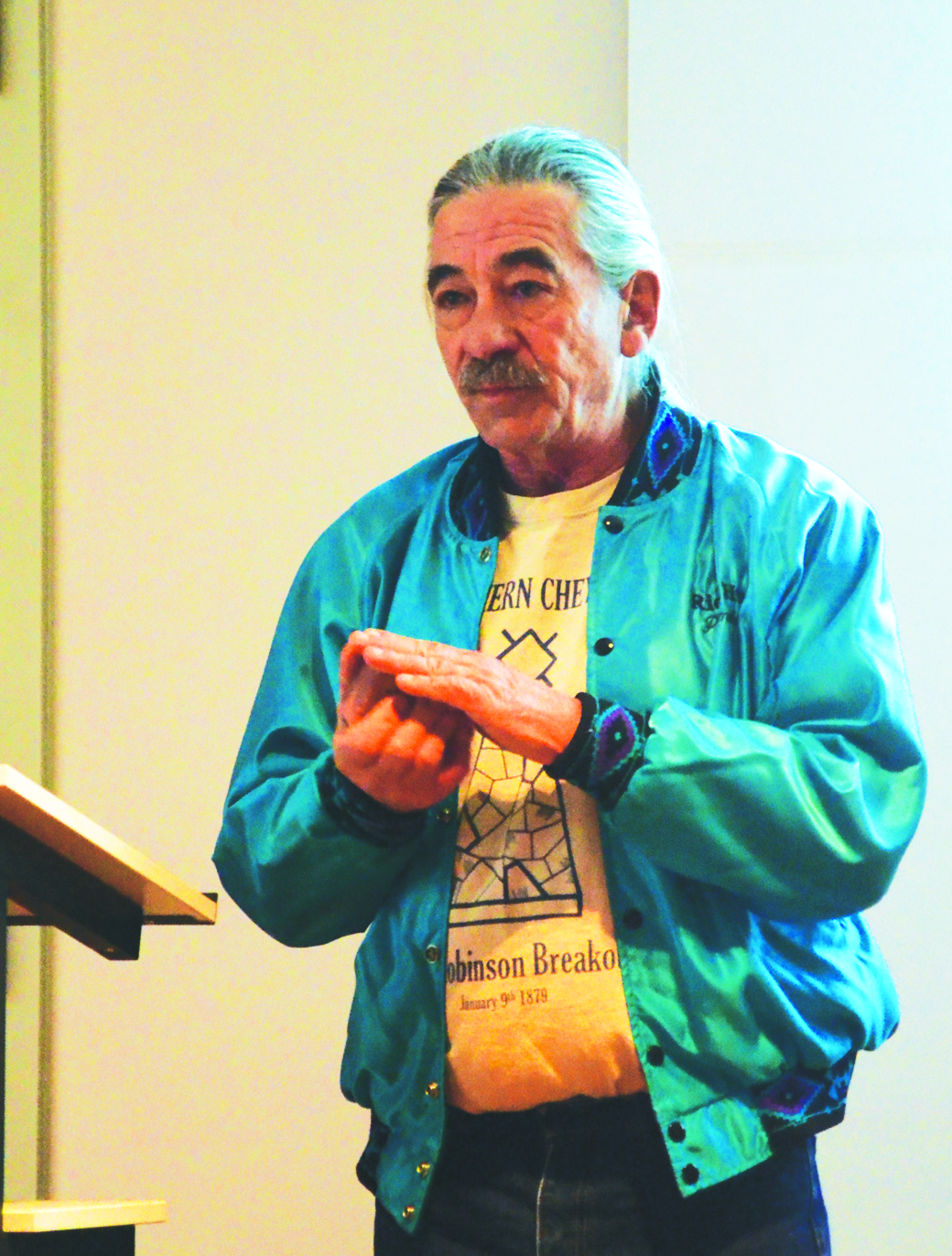
“If everyone understood the pipe, the world would be a much better place,” Hull said.
This is because the person holding the pipe can only tell truths, according to Hull. If a person is dishonest while holding the pipe, they would die and this is why the chief in the group would hold the pipe. Tribesmen would often bring these pipes to peace treaties with whites, and were dubbed “peace pipes”.
Many people associate the use of a pipe with marijuana or drug use. For Hull’s ceremonies he burns tobacco, sage, sweet grass, cedar, but the smoke is not inhaled. In their belief system, sage takes away bad spirits. Sweet grass is used to purify the area, cedar is used to bless the people, and tobacco is given back to mother earth since it was the first herb given to man. Tobacco is sprinkled on the ground before a ceremony to give back to mother earth.
Each ceremony would begin with a prayer, just as Hull’s presentation did. The people engaging in the ceremony would pray to their brothers from each of the cardinal directions; east for wisdom, south for warmth, west for rest or darkness, and north for cold or winter.
The pipe is made up of two pieces—the ‘T’ shaped stone and the stem that is often decorated and made of wood. The length of the stem is roughly 2 feet, and is designed to be too long for one person to light on their own.
The stone for the pipes comes from only one location— Pipestone, Minnesota. The rock in this area was not integrated with salt while it was part of a delta bed millions of years ago, and this makes it easier to carve. These rocks are unique in that they do not crack with temperature changes and do not erode when washed in water. The only tools Hull uses on the rocks are saws, files, and sandpaper.
Getting to the rock “is a spiritual endeavor all in itself,” Hull said.
The quarry in Pipestone, Minnesota ,is considered sacred land to the Native Americans and no heavy-duty excavation equipment is used to pull the rock from the earth. This makes the extraction a labor-intensive process that consists of lots of shoveling, hammering, and sweating. Hiawatha Lake in Pipestone, Minnesota, was formed when a large quarry was flooded in a single night. This happened to be after a group of white excavators were extracting large quantities of the pipe stone and left all their equipment in the bottom of the newly formed lake.