
‘Damaged Goods’ is timeless social commentary
I’ve never cared for the punk rock cliche of patches and spiky jackets, which is why I’m quite partial to the English post-punk outfit, Gang of Four.
Named after the infamous “Gang of Four,” a group of Chinese communist counter-revolutionaries who were unseated in the 1970s, Gang of Four has had a long career and inspired a host of bands ranging from Ian McKaye’s Fugazi, to Rage Against the Machine.
It’s a painfully tired gimmick for punk bands to politicize their music, and if you doubt it, just look at how many band names contain the prefix “anti-“ or the word “against.” In-spite of this, I think Gang of Four is one of the few bands that can make the seamless bridge by balancing between interesting musicianship and strong social statements.
If you have 10 minutes, go to Youtube and check out their first release, 1978’s “Damaged Goods” EP. Rather than angrily raging against machines, Gang of Four uses biting cynicism to critique love, sexuality, and conflict.
The A-side, “Damaged Goods”, has a catchy bass line working its way through stabbing guitar riffs. The lyrics explore the darker side of doomed relationships, which reminds me of a lament penned by graphic artist Jenny Holzer during the same time period, “What urge will save you now that sex won’t?”
The title track digs unapologetically, exploring how shallow relationships will inevitably wreck you as a person, and provides a necessary counter to the idiotic pop-music narrative that glorifies sex as a grandiose act that heals all.
The B-side contains two songs; “(Love Like) Anthrax,” and “Armalite Rifle.”
The second track, “(Love Like) Anthrax,” is one of my personal favorites because it’s such a peculiarity. The intro is strange and dissonant; its open and has lots of space in between the notes. It reminds me a lot of the intro to Big Black’s 1983 song “Cables.”
The drums finally enter with a weird thumping syncopation, while the bass line is almost a punchy dance rhythm. The lyrics are split between two channels; the left channel glibly speaking about how “Love will get you like a case of anthrax, and that’s something I don’t want to catch.”
The right audio channel contains a spoken word account of the technical details used to record the song while occasionally syncing with the left channel during key points in the verse. When the band re-recorded the song for their first album, “Entertainment!” the right channel was replaced with an important manifesto:
“Love crops up quite a lot as something to sing about, ‘cause most groups make most of their songs about falling in love, or how happy they are to be in love. You occasionally wonder why these groups do sing about it all the time. It’s because these groups think there’s something very special about it. Either that or else it’s because everybody else sings about it and always has. You know, to burst into song you have to be inspired, and nothing inspires quite like love. These groups and singers think that they appeal to everyone by singing about love, because apparently, everyone has or can love, or so they would have you believe, anyway. But these groups seem to go along with what, the belief that love is deep in everyone’s personality? I don’t think we’re saying there’s anything wrong with love, we just don’t think that what goes on between two people should be shrouded with mystery.”
The final track, “Armalite Rifle,” is about the lightweight semi-automatic rifle that became popular with police and the Irish Republican Army.
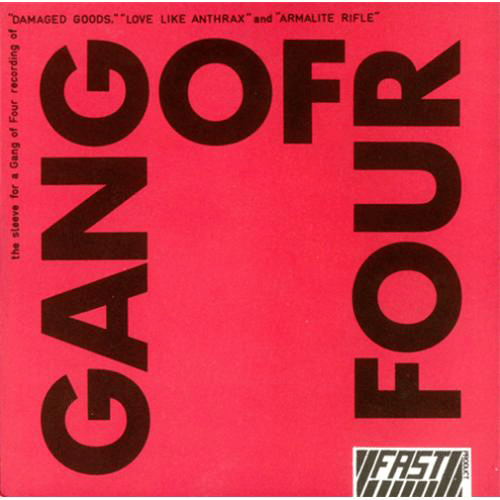
The song begins with an almost marching snare drum fill. The lyrics begin almost as a homage to the lightweight qualities of the Armalite, but quickly turns into condemning its use. Several lines are particularly poignant; “Armalite rifle and the holy trinity; it’s used against you, like Irish jokes on the BBC.” I think it’s far better than any anti-violence song U2 has put out over their career. “Armalite Rifle” continues to find relevance in the current U.S.-funded proxy wars in the Middle East, which makes the song an ever-applicable piece about the damage done by arms proliferation.
“Damaged Goods” quickly climbed to the top of the indie charts after it was first released, which garnered the attention of EMI. Gang of Four was signed and released a few albums, but due to their uncompromising nature regarding their message, they were treated with censorship. An appearance on the BBC’s “Top of the Pops” was canceled, their records were blacklisted, and EMI decided to back off and promote another band.
What was that band? Duran Duran; because vapid New Wave-nonsense like “Hungry Like the Wolf” was deemed to be both more palatable and more meaningful than catchy cultural criticism. If there were ever an enduring testament to the fact that New Wave sucks, that would be it.
While the band has seen several line-up changes over the years, Gang of Four continues making important records that cast off the pretentiousness of “artistic vision.” The fact that their first release can still be relevant more than 35 years later says something. Gang of Four will be releasing their next album, “What Happens Next” on Feb. 24. I am waiting for it with giddy anticipation, but I can settle going through the back catalog for the time being. I don’t know about you, but I wouldn’t be too upset if it showed up on my iPod uninvited.