
Spring recitals brighten CSC
Students entertain small audience at Honor’s Recital
Outside, the cloudy sky seemed to cast a dreary feel into the Mari Sandoz Chicoine Atrium while the audience of roughly 20 waited for the Honor’s Recital to begin.
The afternoon’s first performer, Jedd Raymond, senior of Ainsworth, and Accompanist Bobby Pace, were greeted with applause which echoed loudly around stone and glass of the Atrium.
Raymond, while able to play all four types of saxophone (soprano, alto, tenor, and baritone), played the tenor, accompanied by Pace on the piano. He played only one piece but, unlike the other performers of that afternoon, he played two parts, “Sir Gawain Returns,” and “Luciano and Frederic,” both from “Beyond the Influence,” by Michael Stephens.
While she looked nervous, Natsuki Sato, junior applied music major of Oita-Shi, Japan, took over the piano after Pace and Raymond left the stage. Her song, “Nocturne in E-flat Major, Op. 9, No. 2,” by Frédéric Chopin, was a slow and somewhat mournful piece. The notes flowed together nicely and the tune had a bit of a lullaby feel to it, but it was a bit darker than most mothers probably play for their children at bedtime. 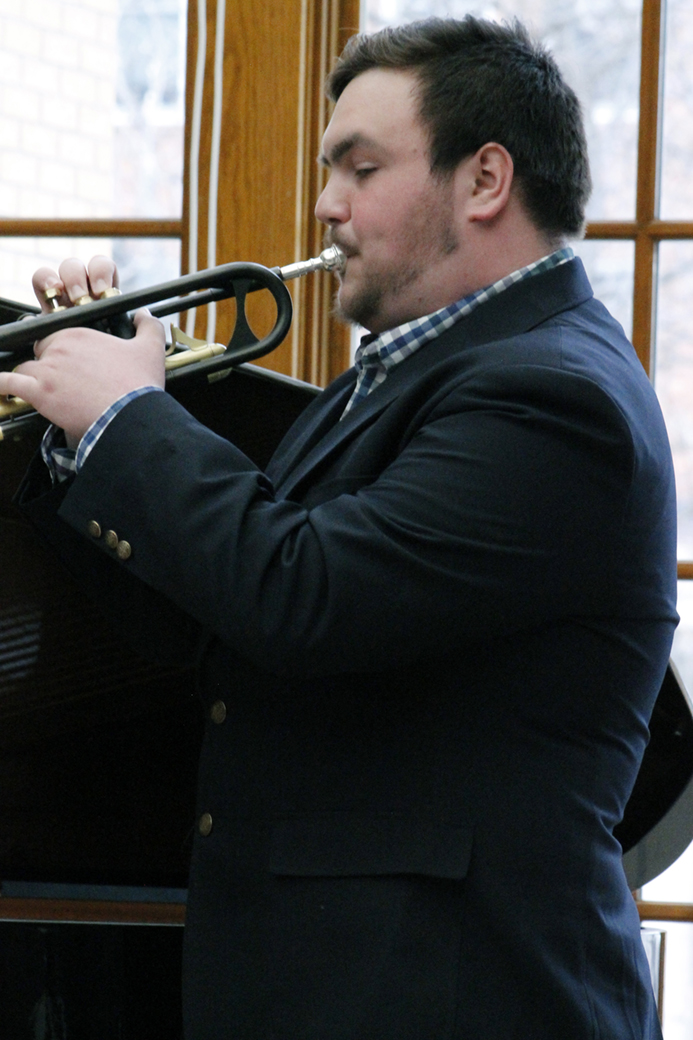
A break from the more traditional instruments, Jake Voorhis, junior of Belle Fourche, South Dakota, played the guitar. While his instrument may not have been classical, his performing piece was: “Prelude No. 1,” by Heitor Villa-Lobos. There were times when he sounded like he may be a bit flat, but overall, he was a talented artist. There were several sliding notes in the song and he used the entire neck of the guitar, his hand quickly sliding from one end to the other while the fingers of his right picked quietly at certain strings.
Once Voorhis finished his piece, unplugged his guitar and exited the stage, sophomore of Kimball, Kallie Bush, came out to play the piano. “Andante,” the first part of “Piano Sonata in G Minor, Op. 49, No. 1,” by Beethoven, was a quick sounding piece, though it was just as flowing as Sato’s song, only with a much less mournful feel.
Pace followed Aydin Mack, trumpet player and sophomore of Alliance, onto the stage for the final performance. Théo Charlier wrote Mack’s piece, “Solo de Concours,” which included two parts where Mack used a mute and illustrated his control and ability to play both loud and soft.
No matter the instrument, it is always a hint at talent and control when one can play softly—anyone can play loud if you just blow enough air, but playing soft takes more practice and skill, especially to do it in a way that doesn’t sound airy and is in tune. Raymond also demonstrated a fantastic amount of control with the soft notes of his song and with this, I am speaking from experience. Playing softly on a woodwind is no easy feat.
Raymond, Sato, and Mack were also selected to play in the Nebraska Intercollegiate Band.
Shuler, Hafey exhibit wide array of talents at recital
Roughly 30 people gathered in Memorial Hall’s Auditorium to listen to Assistant Professor, music, and Director of Brass Studies and Band Sidney Shuler, and Assistant Professor, music, Brooks Hafey.
They entered to applause.
Per the program, Shuler has participated in many orchestras and has played solo not only in the United States, but also in Spain and Russia. Since he has become the director of bands for CSC, his ensembles have participated in multiple clinics and summer camps. Shuler is a member of the International Trumpet Guild, Music Educator’s National Conference and Phi Mu Alpha Sinfonia.
Hafey also has an impressive background in performance and conducting, according to the program. He has performed in France, Italy and Norway, in addition to his performances within the states.
The first number of Friday night, “Concerto in C minor, Op. 35,” by Dmitri Shostakovich and arranged by T. Dokschitzer, contained four parts: “Allegretto,” “Lento,” “Moderato,” and “Allegro con brio.”
Once the professors reentered the stage, to more applause, Hafey took up a seat at the clavinova, instead of the piano, and Shuler took his place facing the audience.
“Prayer of St. Gregory” was a solemn piece, emphasized by the organ setting on the clavinova. It was exactly what one would imagine would go along with the prayer of a saint.
After this performance, there was a brief intermission in which the lights went up and there was a soft hum from the audience. A few members left, while they were replaced by latecomers to the recital. As the lights dimmed again, the audience once again fell silent and Hafey and Shuler took the stage.
Henri Tomasi’s “Tryptyque” had three parts, “Scherzo,” “Largo,” and “Saltarelle.”
Also containing three parts, Hafey and Shuler finished with “Sonata for Trumpet and Piano,” by Eric Ewazen, but not before Hafey entered the stage alone for a few moments, followed briefly by Shuler who told the audience, “one moment.” Shuler quickly disappeared off stage again while Hafey proceeded to the piano looking amused.
“He (Shuler) forgot his mute,” Hafey explained as he sat.
Shuler soon returned, mute in hand, and they began the Ewazen number, which was broken down into “Lento – Allegro Molto,” “Allegretto,” and “Allegro con Fuoco.”
Shuler and Hafey exchanged a pleased smile once the song was over before both rose and took a bow together. They exited the stage to applause and, after the applause continued, they returned for another bow before leaving permanently.