
‘Yonkers’ deserves praise
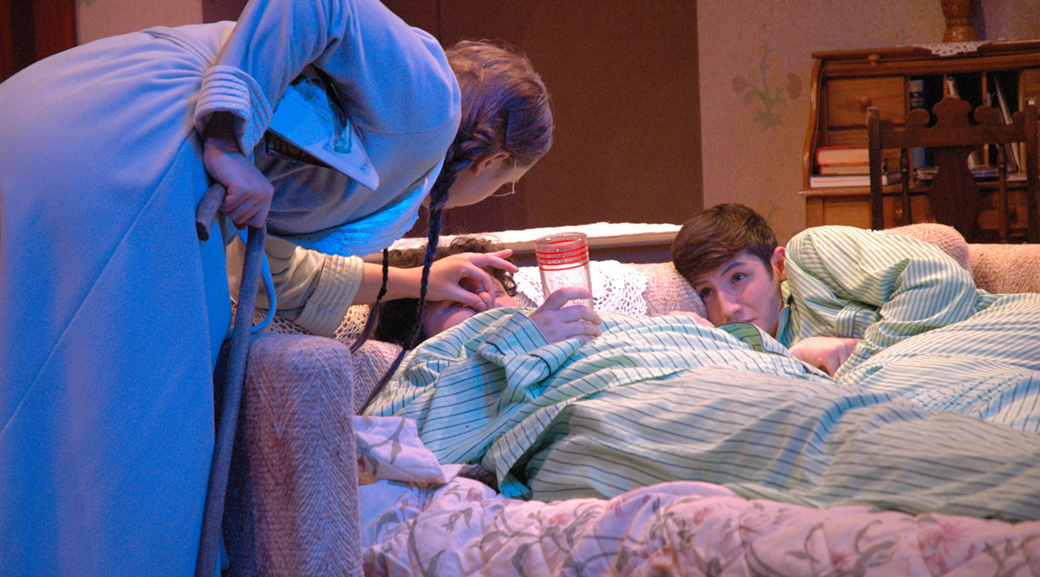
“I’m like steel mama, isn’t that how we’re supposed to be?” Mackenzi Loyd, freshman of Big Piney, Wyoming, delivers a pathos that slips the audience into gentle catharsis. The Black Box Theatre inside Memorial Hall, bleeds a tear.
“Lost in Yonkers,” by noteworthy playwright Neil Simon, details a Jewish American family residing in Yonkers, New York. The family is composed of seven members: Jay and Artie (teenage sons), Eddie (father), Bella (intellectually disabled aunt), Grandma Kurnitz (stern, traditional grandma), Louie (“wise guy” uncle), and Gert (nervous, accommodating aunt). Eddie acquires debt and leaves the Bronx as a scrap iron salesmen, and leaves his two beloved sons behind. The sons are thrown into the world of their German immigrant grandmother, Uncle Louie, and aunts, Bella and Gert. Here, in their grandmother’s Yonkers apartment, Jay and Artie must adjust to the travails of life and stick to their father’s parting words, “Never take for yourself, or you’ll always be obligated,” spoken with conviction by student, Samuel Thomas Martin, junior of Hot Springs, South Dakota.
Jay, played by Wacey Gallegos, senior of Ainsworth, and Artie, played by Brei Royle, freshman of Litchfield, take on the heavy task of setting the dynamic of a fractured family; Bronx accents included. Jay delivers a tone of fear in the beginning which slowly shifts to one of pity for his family by the end. His brother, Artie, portrays the perfect picture of naïve youth, and he sticks to the accommodating vernacular with deft (supplying enough laughter to fill a NYC borough).
Complications of the play rise and fall around the notable chemistry of Gallegos and Royle. Alongside the brothers runs the persuasions of their Uncle Louie, played by Nathan Wojciechowski, junior of Gering. Louie’s attempts to draw the brothers into crime fail, and ultimately, Louie faces his faults as Wojciechowski makes superb use of “stage space” while making written dialogue feel like improvisation.
A story thread through the brother’s lives is the ideal vision of Aunt Bella, played by Loyd. Bella, carries an indelible happiness, suited to the character’s disability, and uses this to hold the fractured family together. A mellifluous delivery of passion in Act 2, Scene 2 by Bella levels the family’s petty grievances, and is one of the standout points in the play. Bella targets her troubles at the confined, harsh nourishment of her mother, Grandma Kurnitz, played by Taylor Thies, freshman of Rapid City, South Dakota. Thies, as Grandma, delivers a cold German dialect that speaks of a life of pain. Thies’ character shift is stunning, and her verbal abuses and door slams turn into the subtle smiles of a championed mother. Among the conflict of Bella and Grandma sits the hilarious, nervous method of speech by Aunt Gert, played by Courtney Smith. Smith faces the daunting task of breathing in while speaking, and it helps the audience see the tensions of the family manifested in a speech disorder.
At its heart, this play is a story of survival, but in its mind the play is “the language and communication of family.” Play director, Molly Thornton, senior of Riverton, Wyoming, casts characters beautifully in sending these messages. Scene and act transitions were seamless, and all seven characters fit the picture in my head before they arrived on stage, and once they arrived they were prepared with a meticulousness that only comes from great direction.
As the lights come on at the end of the play, Bring Crosby’s “Be Careful It’s My Heart” (fitted perfectly to 1942) sifts through the speakers, and I arise feeling. That’s all, just “feeling.” This play makes you feel human, and the detail of work involved with “Lost in Yonkers” is a special gift, delivered by a spectrum of talented individuals at Chadron State College. American author, John Steinbeck, once delivered a quote about “the courage of unqualified praise,” and that is all I have for this play: praise.